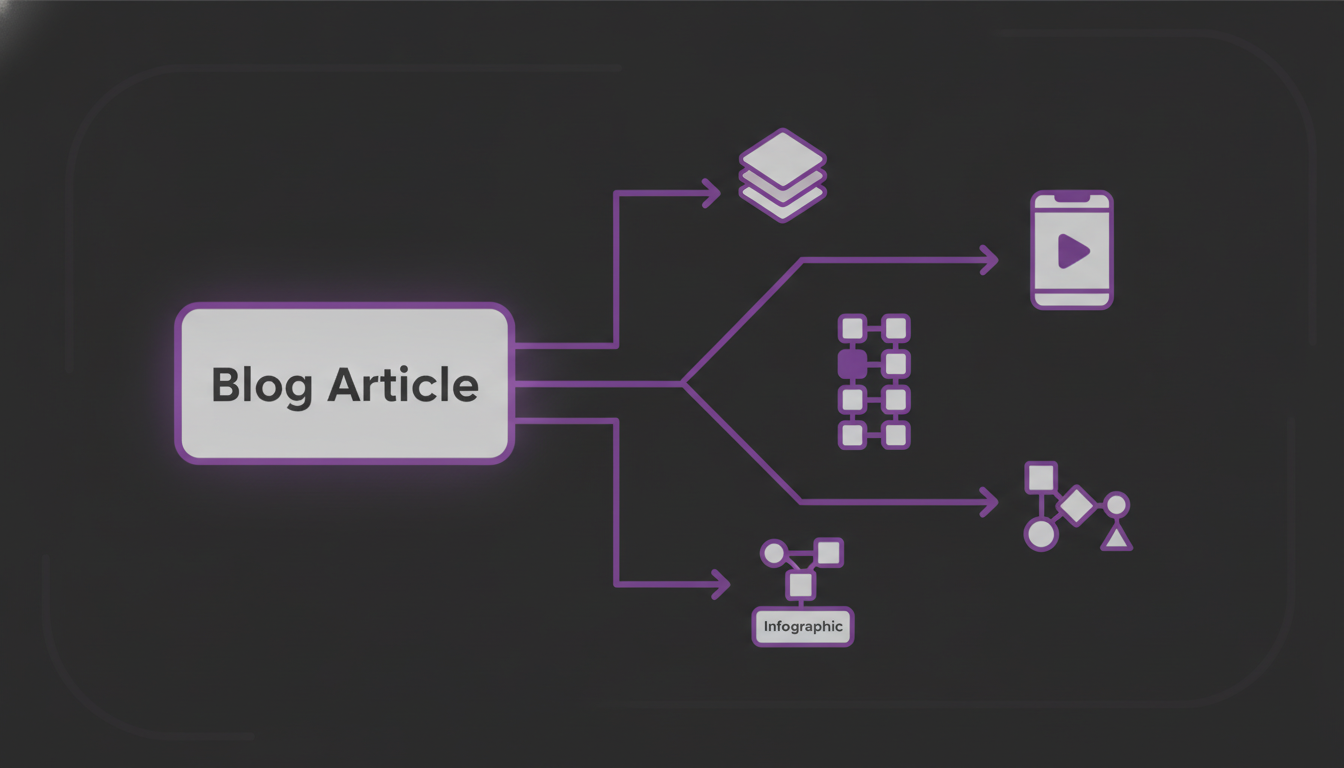
Content repurposing means taking one piece of content and reshaping it into multiple formats for different platforms. Instead of starting from scratch every single day, you work smarter by extracting maximum value from what you have already created. According to HubSpot, marketers who repurpose content see up to 3x more traffic without producing more original material.
- Repurposing one piece of content into multiple formats can multiply your reach without increasing your workload proportionally.
- A single long-form article can generate 10 or more derivative pieces across different platforms.
- Different platforms require different formats - the same message needs to be adapted, not just copy-pasted.
- A structured repurposing workflow cuts content production time by up to 60% according to Semrush data.
- Consistency across platforms builds brand recognition faster than sporadic high-effort posts.
What exactly is content repurposing and why does it matter?
Content repurposing is the practice of taking existing content and adapting it into new formats, channels, or audiences without rebuilding the core idea from zero. It is not about lazy recycling - it is about strategic amplification. One well-researched blog post, for example, already contains enough material for a week of social content.
The numbers back this up clearly. Semrush found that 94% of top-performing content marketers repurpose their content regularly. Meanwhile, brands that maintain consistent messaging across multiple platforms see 23% higher revenue than those that do not, according to Lucidpress. Those are not small margins.
Repurposing also improves SEO. When the same topic appears in a YouTube video, a LinkedIn article, a podcast, and an Instagram carousel, you build topical authority across multiple channels simultaneously. Google and other search engines reward this kind of depth.
What types of content can you repurpose most effectively?
Almost any content can be repurposed, but some formats are better starting points than others. The best source content is dense, research-backed, and evergreen - meaning it stays relevant beyond a single news cycle. Think long-form blog posts, webinars, podcast episodes, or in-depth case studies.
Best source formats for repurposing
- Long-form blog posts (1500+ words) - rich in data, quotes, and subtopics
- Webinars and video presentations - already contain structure, visuals, and spoken content
- Podcast episodes - great for transcripts, quotes, and audiograms
- Original research or surveys - full of stats that work across every format
- Case studies - storytelling gold that adapts into carousels, threads, and testimonial content
Short, reactive content like news commentary or trending posts is harder to repurpose because it has a short shelf life. Save your repurposing workflow for your best-performing, most durable material.
How do you build a content repurposing system step by step?
A repurposing system works best when you define it before you create content, not after. The key is to plan your pillar content with derivative pieces already in mind. This changes how you research, structure, and write from the very start.
- Choose your pillar content format. Start with the richest format you can produce - usually a long blog post, a webinar, or a detailed video. This is your content anchor.
- Identify the key components. Break it down into subthemes, data points, quotes, step-by-step instructions, and story moments. Each of these becomes a standalone piece.
- Map each component to a platform. Data points work well as LinkedIn stats posts. Step-by-step sections become Instagram carousels. Quotes become Twitter/X or Threads posts. Full subtopics become YouTube Shorts or TikTok scripts.
- Adapt the format, not just the content. A LinkedIn audience wants professional framing. TikTok viewers want fast, visual storytelling. Never paste the same text across platforms - reframe it for each context.
- Schedule derivatives in a staggered rollout. Spread the repurposed pieces over two to four weeks after the original publishes. This maximizes exposure without overwhelming your audience.
- Track performance per format. After four to six weeks, compare engagement across each derivative. Double down on what worked and cut what did not.
Tools like Brandlix help you manage this process by letting you schedule and adapt content across 10 different platforms from a single dashboard - so the workflow does not collapse under its own complexity.
Which platforms need which content formats?
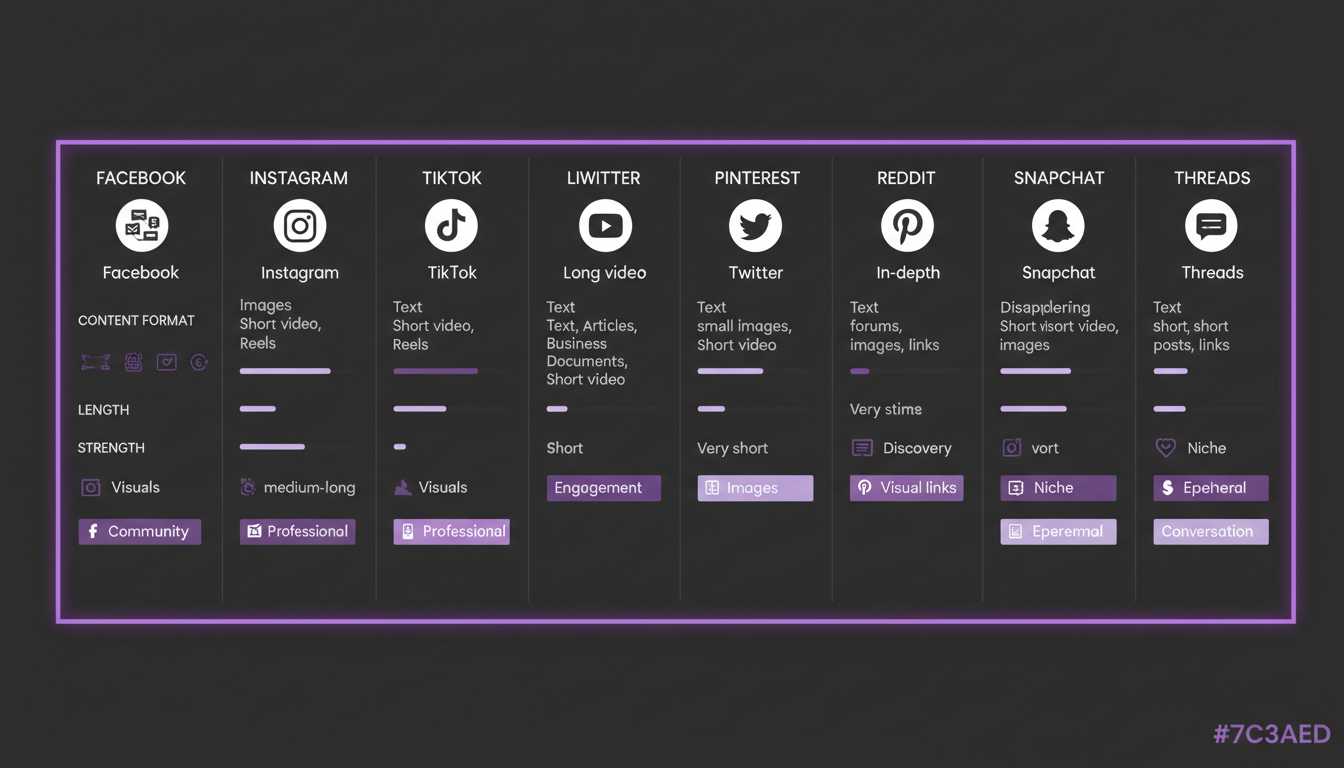
Each platform has its own native content language. Copying the same post everywhere does not repurpose - it just duplicates. Effective repurposing means adapting the same idea to fit the way each platform delivers value to its audience.
| Platform | Best Repurposed Formats | Ideal Content Length | Key Strength |
|---|---|---|---|
| Carousels, Reels, quote graphics | Short captions (125-150 chars) | Visual storytelling | |
| Long-form posts, articles, data stats | 1200-1800 characters | Professional depth | |
| TikTok | Talking-head videos, tips lists | 30-90 seconds | Discovery and reach |
| Twitter/X | Threads, single stat posts, hot takes | 280 chars or threaded | Fast conversation |
| YouTube | Full tutorials, Shorts, recaps | 8-15 min (long) / 60 sec (Shorts) | Search and authority |
| Infographics, step-by-step pins | Visual-first with keyword titles | Long-term evergreen traffic | |
| Threads | Conversational excerpts, questions | 500 characters max | Community engagement |
| Bluesky | Text threads, opinion takes | 300 characters | Niche early-adopter audiences |
| WordPress | Full articles, updated deep dives | 1500-3000+ words | SEO and topical authority |
| Video clips, community posts, events | Medium (80-200 words) | Community building |
What are real-world examples of content repurposing done right?
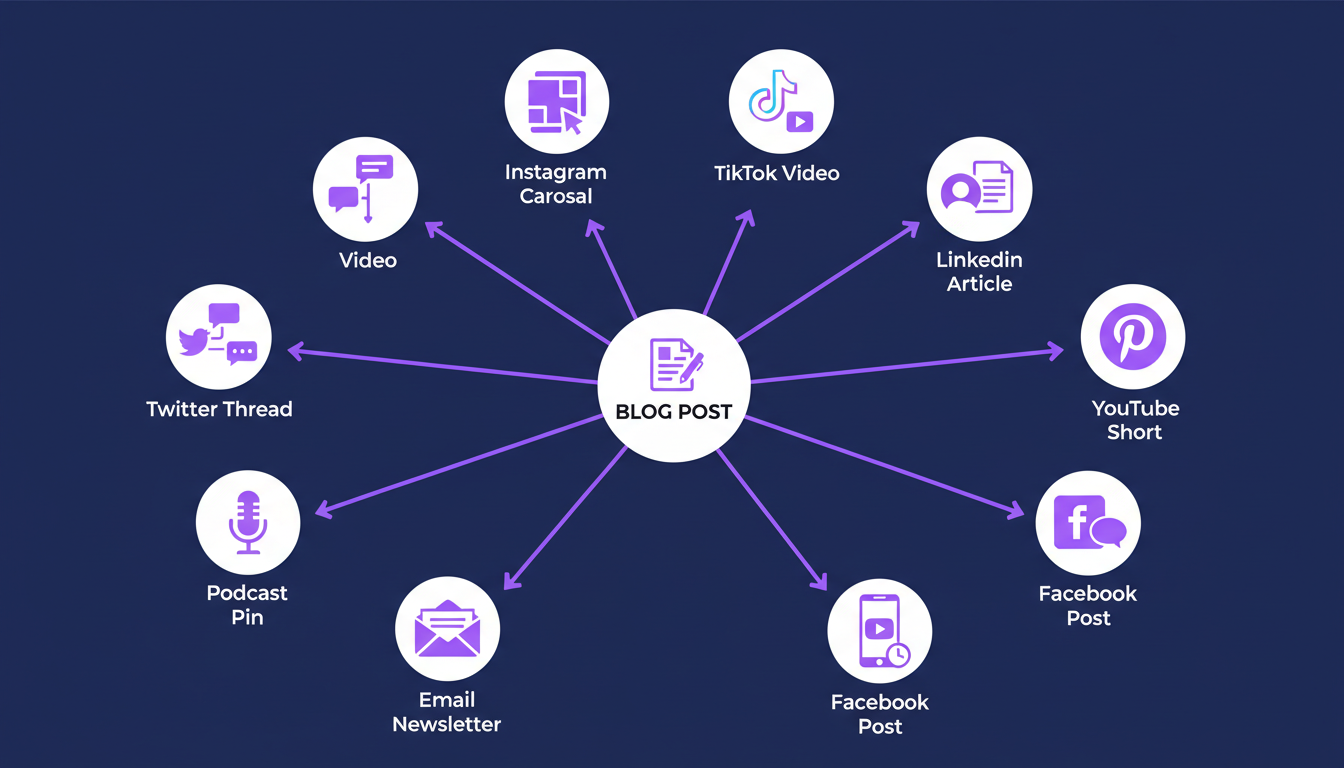
The best way to understand repurposing is to see it in action. A single well-structured piece of content can realistically produce 10 or more derivative assets without reinventing any idea from scratch. Here is a concrete example based on a 2000-word blog post about email marketing strategy.
From one blog post to 10 pieces of content
- LinkedIn article - rewrite the intro and conclusion, keep the structure, link back to the blog
- Instagram carousel - pull the 7 main tips into a slide-by-slide visual breakdown
- TikTok video - record a 60-second talking-head summary of the top 3 takeaways
- Twitter/X thread - turn each major section into one tweet, open with a hook stat
- Pinterest infographic - visualize the step-by-step process from the blog's how-to section
- YouTube Short - use the TikTok script with minor platform-specific edits
- Podcast talking points - use the blog outline as a script for a 10-minute episode
- Email newsletter - summarize the blog with 3 key insights and a CTA to read the full piece
- Facebook post - share a question from the blog's FAQ section to spark comments
- Threads post - post a single controversial or surprising stat from the article with a question
According to Sprout Social, content that is distributed across more than five channels generates 60% more engagement per piece than content published on a single channel. That is significant when you consider that the underlying idea never changed - only its packaging did.
How do you know which content is worth repurposing?
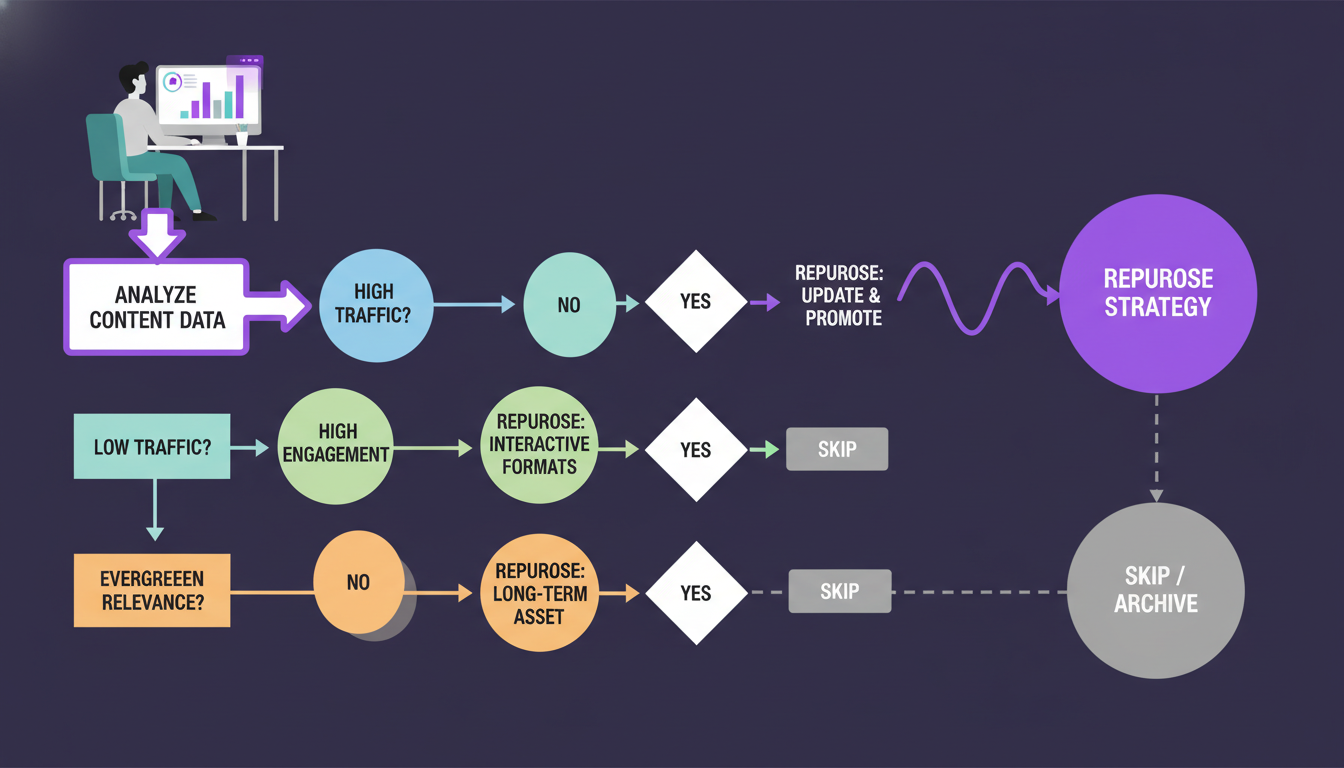
Not every piece deserves the repurposing treatment. The smartest approach is to prioritize content that already proved its value. Look at your analytics and find what already worked, then amplify it further instead of chasing new ideas constantly.
Signals that a piece is worth repurposing
- High organic traffic from search (sustained over 3+ months)
- Strong engagement rate - comments, shares, saves, or replies above your average
- Evergreen relevance - the topic does not expire after a season or news cycle
- Highly searchable topic with clear audience intent
- Content that answers a frequently asked question in your niche
Conversely, avoid repurposing news-reactive posts, time-sensitive announcements, or anything tied to a specific moment that has already passed. These formats do not translate well and can make your brand look out of touch if they surface later.
A 2026 Semrush study found that evergreen content accounts for 38% of total blog traffic for high-performing websites, despite representing a much smaller percentage of total posts. That ratio tells you exactly where to focus your repurposing energy.
What mistakes do marketers make when repurposing content?
The biggest repurposing mistake is treating it as a copy-paste exercise. When you dump the same caption on LinkedIn, Instagram, and Facebook at the same time, audiences notice - and engagement drops. Each platform carries different expectations for tone, length, and visual presentation.
Common repurposing mistakes to avoid
- Same caption everywhere. LinkedIn readers want professional context. Instagram readers want brevity. TikTok viewers do not read captions at all.
- Repurposing outdated content without updating it. Old statistics or outdated advice can damage your credibility. Always refresh data before redistribution.
- Posting all derivatives at once. Flooding your channels simultaneously creates noise but no sustained presence. Spread posts over weeks.
- Ignoring native features. Using Instagram carousels with LinkedIn formatting, or posting a vertical TikTok natively to YouTube without adjusting the aspect ratio, signals low effort.
- No tracking system. Without logging which pieces came from which source, you lose visibility into what is working and you risk repeating the same derivative twice.
Hootsuite's 2026 Social Media Trends report noted that brands posting natively formatted content per platform receive up to 40% more impressions compared to cross-posted content with no adaptation. The effort of adapting format pays back immediately in distribution.
How do you measure the ROI of a content repurposing strategy?
Measuring repurposing ROI comes down to comparing output against input - how much reach and engagement did you generate relative to the time invested in creating new content. The clearest metric is content efficiency: total impressions divided by hours spent producing.
Track these specific numbers for every repurposing cycle:
- Total reach per derivative - impressions or views per platform per piece
- Engagement rate - likes, comments, shares, saves compared to your baseline
- Traffic referrals - how many visits did repurposed pieces drive back to the original content?
- Follower growth - did distribution across more channels accelerate audience growth?
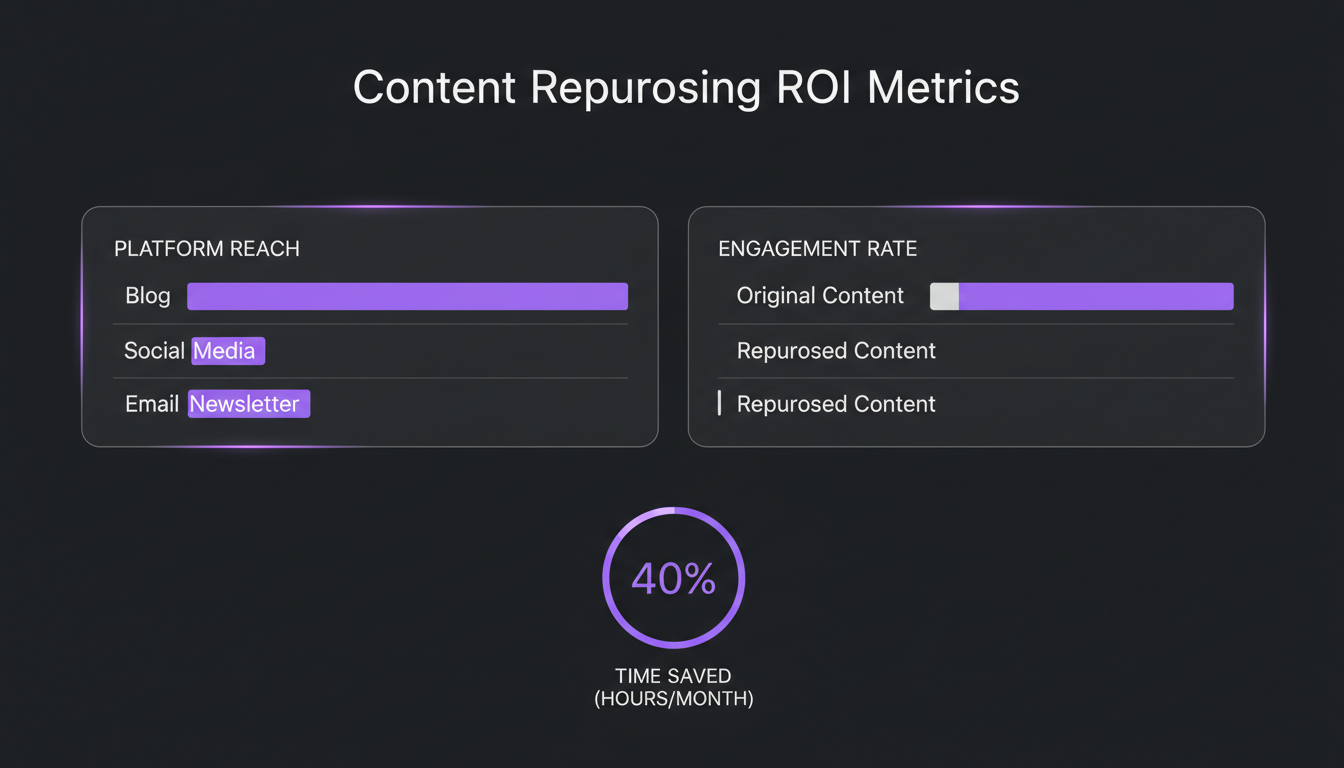
- Time saved - track hours spent repurposing vs. hours that would have gone into creating originals
According to Content Marketing Institute, brands with a documented content repurposing strategy report 62% lower cost per lead than those without one. That number comes from spreading production costs across more pieces rather than paying for net-new content every week.
A simple monthly audit - reviewing which derivatives outperformed the original and which fell flat - gives you the data to improve your process continuously rather than repeating the same mistakes.
Frequently Asked Questions
How often should you repurpose the same piece of content?
There is no hard limit, but a practical rule is to do one full repurposing cycle per strong-performing piece every 6-12 months. Update any statistics or examples, refresh visuals, and re-distribute. Evergreen content can go through two or three cycles before it needs a full rewrite.
Does repurposing content hurt your SEO?
Not if done correctly. The original indexed URL keeps its authority. Repurposed pieces on other platforms (YouTube, LinkedIn, Pinterest) act as external signals that reinforce your topical authority. The risk only appears if you duplicate content across multiple blog posts on the same domain without canonical tags - avoid that specific scenario.
What is the difference between repurposing and cross-posting?
Cross-posting means publishing identical content on multiple platforms simultaneously. Repurposing means adapting the core idea into a new format suited to each platform's audience and native style. Repurposing takes more effort but consistently outperforms cross-posting in engagement and reach.
How many pieces of content can realistically come from one source?
A single 2000-word blog post or 30-minute webinar can realistically generate between 8 and 15 derivative pieces. This includes social posts, carousels, short videos, infographics, email newsletters, and podcast talking points. The ceiling depends on how rich and structured the original content is.
Start building your repurposing system today
Content repurposing is not a shortcut - it is a smarter way to work. When you treat every piece of content as a source rather than a destination, your production system becomes exponentially more efficient. The brands winning on social in 2026 are not necessarily creating more content. They are extracting more value from what they already have.
Start with your three best-performing pieces from the last six months. Map each one to the platform list above. Build five derivatives from each. Track what lands. Then systematize the whole process so it runs without you having to reinvent it every time. Tools like Brandlix make the scheduling and cross-platform management side of that system significantly more manageable. The creative thinking is still yours - that is exactly where your energy should go.