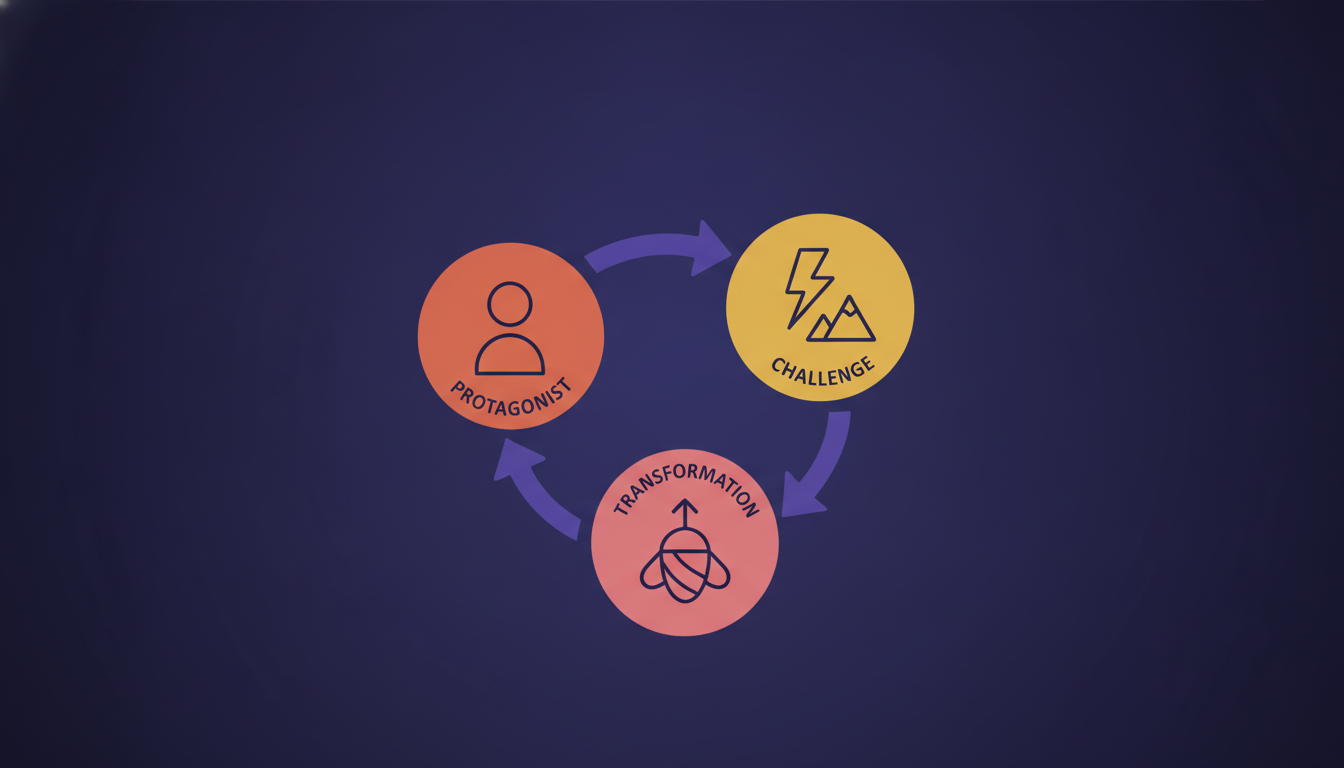
Social media storytelling is the single most reliable way to build an audience that actually cares about your brand. Not just follows - cares. In a feed flooded with promotional posts and recycled tips, a well-told story stops the scroll and creates a memory. This guide breaks down exactly how to do it, platform by platform, with structures you can use today.
- Storytelling on social media outperforms plain promotional content in engagement and retention because it triggers emotional processing in the brain.
- Every strong social story follows a recognizable structure - conflict, tension, and resolution - even in a 15-second Reel.
- Different platforms demand different story formats: long-form narrative works on LinkedIn, fast visual arcs win on TikTok and Instagram.
- User-generated content and founder stories are among the highest-trust storytelling assets available to brands in 2026.
- Consistency matters more than virality - a steady story arc across posts builds brand recognition over time.
What Exactly Is Storytelling on Social Media?
Social media storytelling means structuring your content around a narrative arc - a beginning, middle, and end - rather than simply broadcasting information or promotions. It works because the human brain processes stories differently from plain facts: narrative activates sensory and emotional regions, making the content more memorable and shareable.
This does not mean every post needs to be a 1,000-word essay. A single Instagram carousel can tell a complete story across six slides. A 30-second TikTok can open with a problem, show a turning point, and land on a satisfying conclusion. The format is flexible; the underlying structure is not.
What separates storytelling from regular content is the presence of tension. Something is at stake. A business almost failed. A product solved a problem no one else would touch. A customer's life changed in a specific, concrete way. Without tension, you have information. With tension, you have a story.
Why Does Storytelling Work Better Than Promotional Content?
Story-based content consistently earns higher engagement, longer view times, and stronger brand recall than straightforward promotional posts. The reason is neurological: when people read or watch a story, their brains mirror the emotions of the characters involved - a phenomenon researchers call narrative transportation.
Here are some well-documented patterns worth knowing:
- People remember roughly 65-70% of information delivered in story form, compared to around 5-10% of the same information presented as bullet-point facts alone.
- Emotion is the primary driver of sharing behavior on social platforms - content that triggers a strong feeling (awe, amusement, empathy) travels further than content that simply informs.
- LinkedIn posts that open with a personal anecdote or conflict regularly outperform product-announcement posts in comment volume, even when the announcement reaches more people at the impression level.
- On TikTok, videos with a clear narrative hook in the first 2-3 seconds show significantly higher completion rates than videos that lead with a product or a logo.
The practical implication: if your content calendar is mostly announcements, offers, and tips, you are leaving a significant engagement gap on the table. Filling that gap with story-driven posts does not require a bigger budget - it requires a different structure.
What Story Structures Work Best on Social Media?
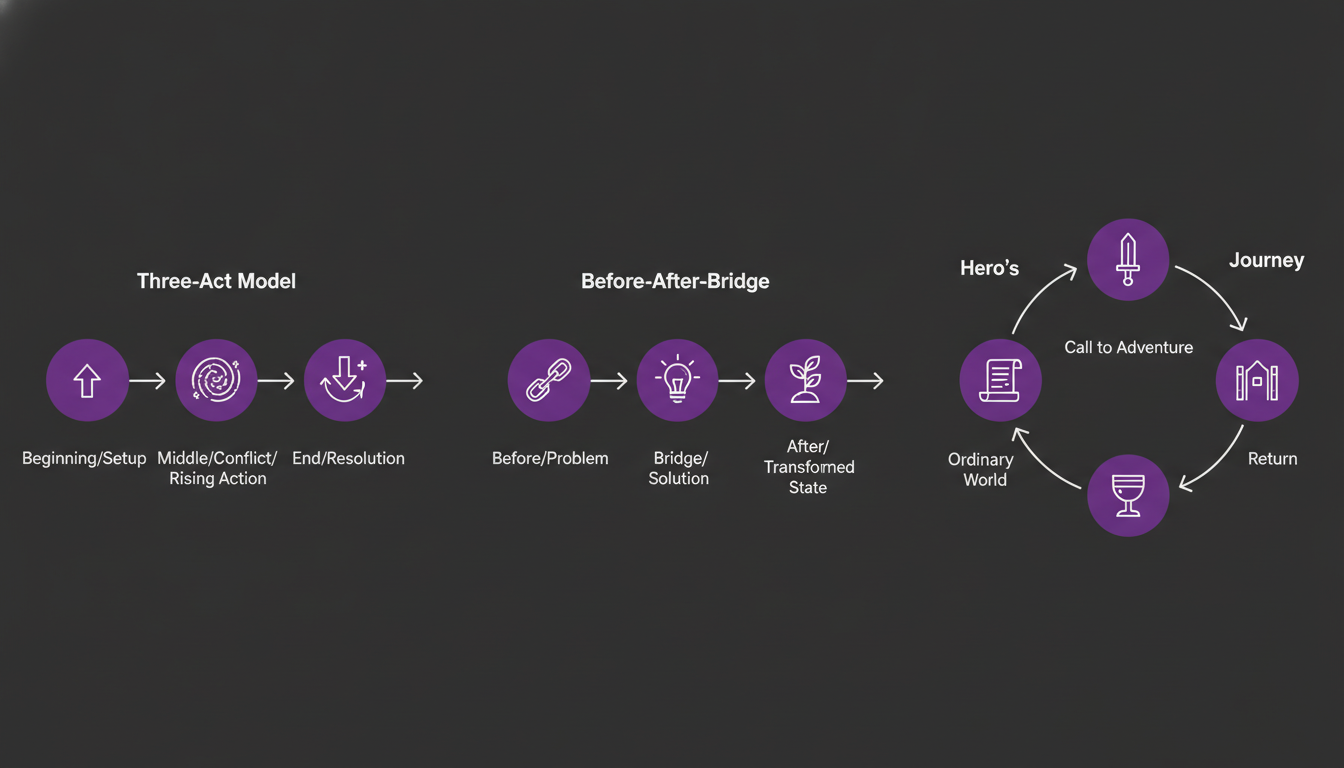
The most effective social media stories follow one of three core structures. Each one works across multiple platforms and content lengths. Choosing the right structure depends on what you are trying to achieve - awareness, trust, or conversion.
The Problem-Agitate-Resolve (PAR) Structure
This is the workhorse of short-form storytelling. You name a problem your audience recognizes, you intensify it by showing the real cost of not solving it, and then you show the resolution. It works in a single tweet, a 60-second video, or a carousel post.
- State the problem - be specific, not generic. "We were spending 12 hours a week on social content with nothing to show for it" hits harder than "content creation takes too long."
- Agitate - what was the emotional or business consequence? Exhaustion, lost revenue, a team about to quit?
- Resolve - show what changed and how. Keep it credible. One concrete result beats three vague improvements.
The Before-After-Bridge (BAB) Structure
BAB is slightly softer and works well for testimonials, case studies, and founder stories. You paint the "before" state (relatable struggle), flash to the "after" state (the desirable outcome), and then bridge the gap by explaining what caused the change.
The In Medias Res Hook
Start in the middle of the action. "I was about to shut the company down when a DM changed everything." This works exceptionally well for TikTok, Instagram Reels, and LinkedIn text posts because the platform algorithm rewards immediate engagement - and nothing earns a stop-the-scroll moment like dropping the reader into a live situation.
How Do You Adapt Your Story for Each Platform?
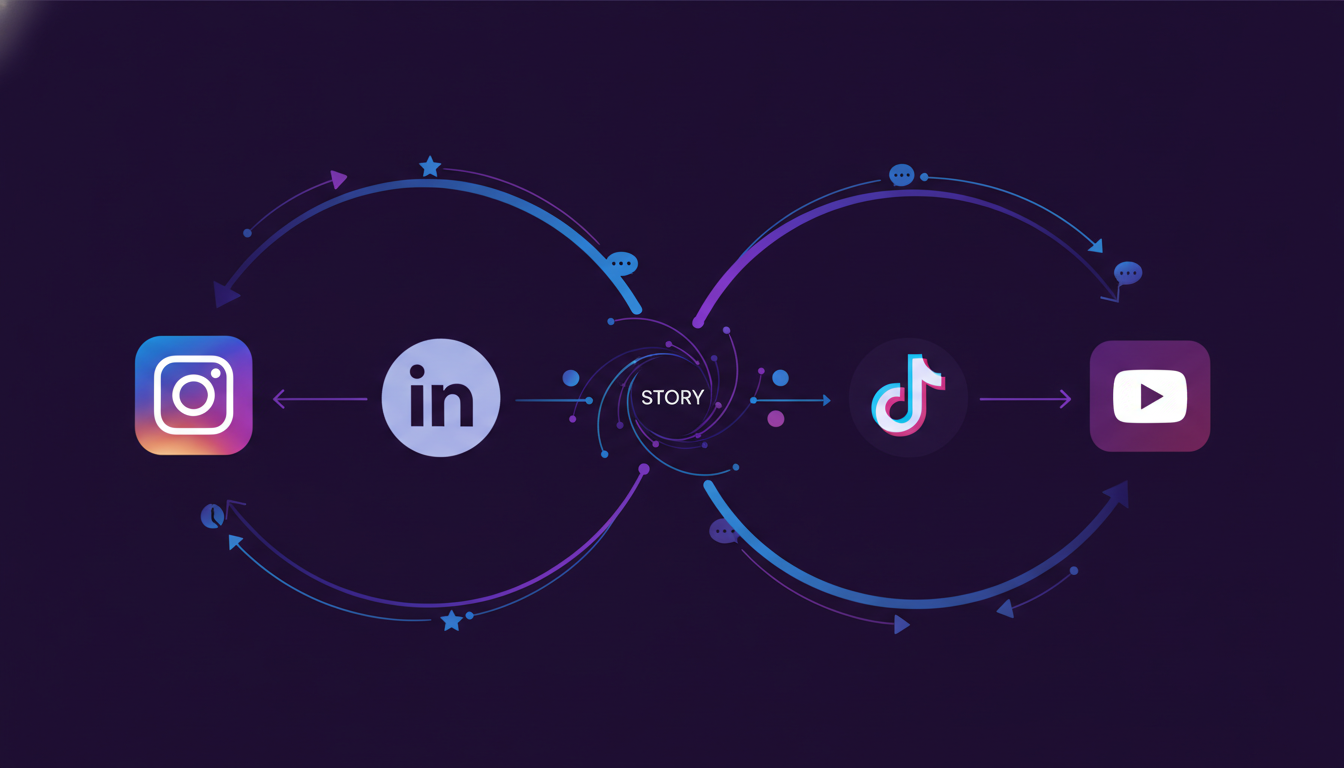
The core narrative stays consistent, but the delivery format must match each platform's native behavior. What works on LinkedIn will feel slow on TikTok. What wins on Instagram may be too visual-heavy for Twitter/X. The table below maps story formats to platform strengths.
| Platform | Best Story Format | Ideal Length | Key Storytelling Hook |
|---|---|---|---|
| Carousel (slide-by-slide arc) or Reels | 6-10 slides / 30-60 sec video | Visual contrast between slide 1 and the final slide | |
| Long-form text post with personal anecdote | 150-300 words | Counterintuitive opening line or vulnerable admission | |
| TikTok | Talking-head narrative or text-overlay video | 30-90 seconds | In medias res drop in first 2-3 seconds |
| Twitter/X | Thread with cliffhanger tweet endings | 5-12 tweets | First tweet must standalone as a hook |
| Long-form post or native video | 200-400 words / 2-5 min video | Community-relevant conflict or shared experience | |
| Sequential pin boards or Idea Pins | 5-15 frames | Transformation visual (before/after aesthetic) | |
| YouTube | Documentary-style or vlog narrative | 8-20 minutes | Stakes established in first 60 seconds |
| Threads / Bluesky | Conversational story thread | 3-8 posts | Relatable observation that opens a bigger question |
Managing story arcs across eight or more platforms simultaneously is where most content teams hit a wall. Tools like Brandlix's content calendar let you map your narrative threads visually across platforms, so you can see at a glance whether your storytelling is consistent or fragmented.
What Types of Brand Stories Get the Most Engagement?
Not all stories perform equally. The highest-engagement brand stories fall into five repeatable categories. You do not need to invent a new narrative category - you need to execute one of these consistently and well.
1. Founder and Origin Stories
Why did you start this? What problem were you personally experiencing? Founder stories work because they attach a human face to a brand. They also tend to be inherently conflicted - nobody starts a company because things were going smoothly. The origin story is almost always a story of friction, doubt, and a decision made against the odds.
2. Customer Transformation Stories
This is the social proof format with the highest trust ceiling. A customer explains where they were before, describes what changed, and shows where they are now - in their own words and ideally in their own voice. This differs from a testimonial because it follows a narrative arc rather than just stating a verdict.
3. Behind-the-Scenes Stories
Showing the process - the messy kitchen, the failed prototype, the team arguing over a product name - builds authenticity. Audiences in 2026 are highly attuned to polished corporate content and respond more warmly to content that lets them see what actually happens behind the brand.
4. Failure and Recovery Stories
Counterintuitively, sharing a failure often builds more trust than sharing a success. When you describe what went wrong and what you learned, you demonstrate self-awareness and credibility. This format consistently earns high comment volume because it invites others to share their own experiences.
5. Community Stories
Featuring your customers, followers, or community members as the protagonists of your content shifts the story away from you and toward the people you serve. User-generated content (UGC) campaigns that tell real customer stories can deliver significantly better reach than brand-produced content, because they feel more authentic and because the featured person shares the content to their own network.
How Do You Build a Consistent Story Arc Across Multiple Posts?
A single story post is good. A connected story arc across weeks or months is what builds a loyal audience. The key is treating your content calendar as a serialized narrative rather than a collection of one-off posts.
- Define your brand's core tension. Every enduring story has a central conflict. For a brand, this is usually: the problem your audience faces vs. what the world could look like if that problem were solved. Write this tension down in one sentence and make sure every story you publish connects to it.
- Create recurring story formats. Give your audience a pattern to recognize - a weekly "behind the scenes" Friday post, a monthly customer spotlight, a quarterly founder reflection. Recurring formats reduce the cognitive load of content planning and train your audience to expect and look forward to specific content.
- Plant callbacks and forward references. Reference an earlier post ("Three months ago I shared why we almost stopped shipping this product..."). This rewards loyal followers and gives new followers a reason to scroll back through your archive.
- Track narrative fatigue. Engagement data will tell you when a story arc has run its course. Watch for declining comments and saves on story-format posts - that is your signal to introduce a new narrative thread.
- Use your analytics to identify which story types convert. Not all story formats are equal for your specific audience. The Brandlix analytics dashboard lets you segment performance by content type so you can double down on what actually works rather than guessing.

What Are the Most Common Storytelling Mistakes on Social Media?
Most brands make the same handful of storytelling mistakes. Knowing them in advance saves you months of trial and error.
Making the Brand the Hero
This is the most common and most damaging mistake. Your brand is not the hero of your story - your customer is. Your brand is the guide, the tool, the mentor. The moment you position your product as the protagonist, your audience disengages because they cannot see themselves in the story. Put your customer at the center. Always.
Skipping the Conflict
Many brands jump straight from "here is our product" to "here are the results" without pausing on the struggle in between. The struggle is the story. Without it, the resolution feels unearned and the audience has no reason to care. Spend more time on the problem than you think is comfortable.
Inconsistent Voice Across Platforms
If your LinkedIn posts sound like a corporate press release and your TikTok sounds like a completely different company, you are fracturing your brand narrative. Your tone should shift slightly by platform - more formal on LinkedIn, more conversational on TikTok - but the underlying values, language choices, and story themes should remain consistent. This is a lot easier to maintain when you plan content centrally. The AI content tools in Brandlix help you adapt a single story idea into platform-native formats without losing your brand voice.
No Clear Call to Action Within the Story
A great story that ends without direction wastes its momentum. The CTA does not have to be a hard sell - "save this for when you need it," "tag someone who needs to hear this," or "reply with your version of this story" are all story-native calls to action that extend engagement without feeling transactional.
Treating Every Post as Standalone
Social media algorithms favor accounts that create habitual viewing behavior. If every post is disconnected from the last, you are not building a loyal audience - you are starting over with each piece of content. Even a loose thematic thread between posts signals to both the algorithm and your followers that there is more to come.
How Do You Measure Whether Your Storytelling Is Working?
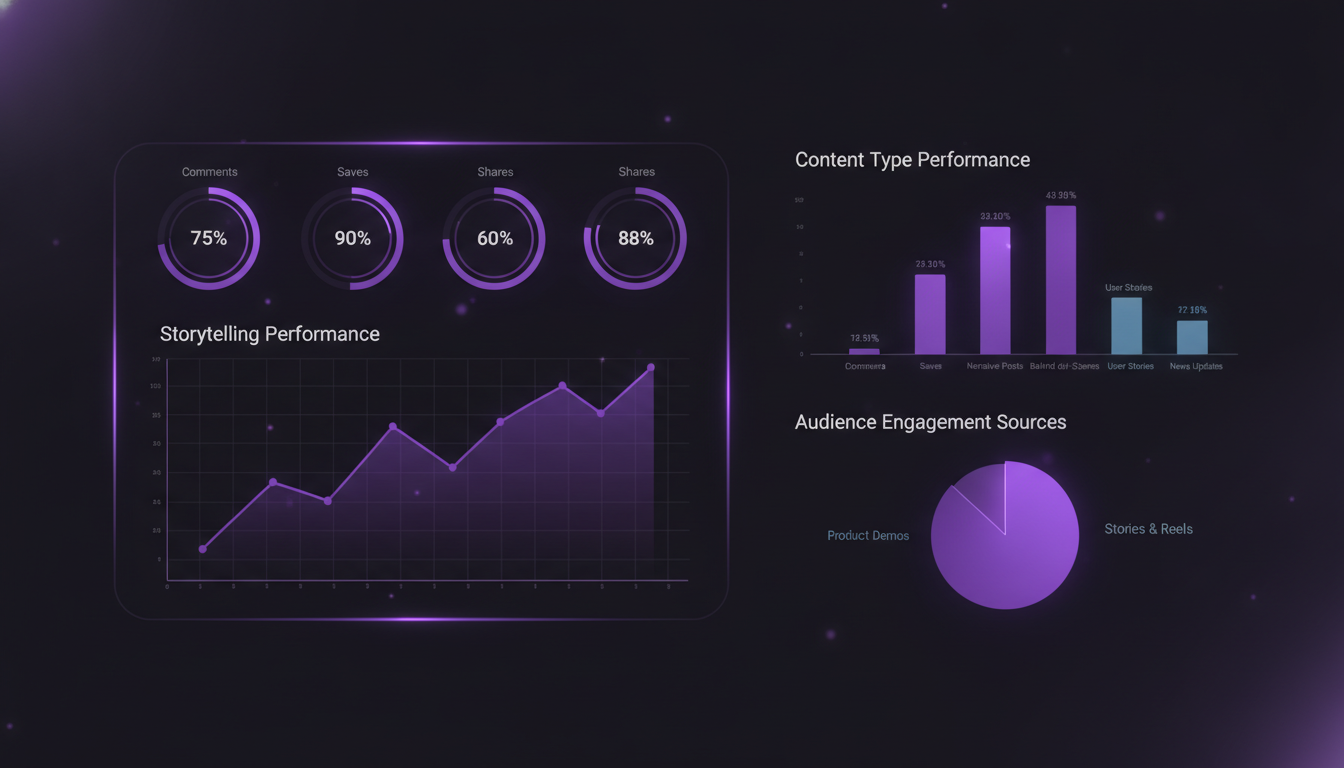
The right metrics for storytelling are different from the right metrics for promotional content. Reach and impressions tell you how many people saw the story. But saves, shares, comments, and watch-through rate tell you whether the story landed.
- Save rate - People save content they want to return to. A high save rate on a story post means it resonated enough to be worth keeping.
- Comment quality - Are comments one-word reactions or are people sharing their own experiences? The latter means your story triggered genuine engagement.
- Share rate - Sharing is the highest endorsement on most platforms. People share stories that make them look thoughtful, empathetic, or insightful to their own network.
- Video completion rate - For video storytelling, watch what percentage of viewers make it to your resolution. A sharp drop-off at a specific point tells you exactly where the story lost tension.
- Follower growth rate after story posts - Well-told stories often trigger follow spikes because people want to hear what happens next.
Set a 30-day baseline for each metric before measuring storytelling impact. Give your narrative at least 60-90 days to compound before drawing conclusions about what is and is not working. Good storytelling builds slowly and then accelerates - the results rarely come in a single viral post.
If you want a structured way to track and schedule your story-driven content, the content calendar and analytics tools are built precisely for this kind of ongoing narrative management across multiple platforms.
Frequently Asked Questions
How long should a social media story post be?
Length depends entirely on the platform and format. On LinkedIn, 150-250 words is the sweet spot for text-based story posts. On TikTok and Instagram Reels, 30-90 seconds is the range where completion rates stay strong. Twitter/X threads work best at 5-10 tweets. The rule of thumb: make it as short as possible while still giving the conflict and resolution enough space to breathe. Cut the setup, never the tension.
Do I need to share personal stories to do social media storytelling well?
No - personal stories are one option, not the only option. You can tell customer stories, product origin stories, behind-the-scenes process stories, or industry narrative stories without sharing anything personally vulnerable. That said, posts with a personal human voice - even if the subject is a business topic - consistently earn stronger engagement than purely third-person brand narratives. You do not have to overshare; you just have to be present in the story.
How often should I publish story-driven content versus other content types?
A sustainable mix for most brands is roughly 30-40% story-based content, with the remainder split between educational, promotional, and community posts. Starting at one dedicated story post per platform per week and measuring engagement is a practical way to build the habit before scaling. Storytelling content typically takes more planning time than simple tip posts, so building that capacity gradually prevents burnout.
Can storytelling work for B2B brands, or is it mainly a B2C strategy?
Storytelling works particularly well for B2B brands because B2B buyers face longer, higher-stakes decision cycles and are actively looking for evidence of trust and credibility. Case studies structured as narrative arcs, founder posts about why the company exists, and behind-the-scenes content about how products are built all perform strongly in B2B contexts - especially on LinkedIn. The emotional drivers are different (professional risk, ROI, peer validation) but the storytelling mechanics are identical.
Social media storytelling is not a trend to experiment with - it is the baseline skill that separates brands that build communities from brands that just maintain a presence. Start with one story format, apply a clear narrative structure, and measure what lands. Then do it again, better. The audience for your brand's story is already out there. They just need a reason to stop scrolling.
If you want to plan, create, and publish story-driven content across all your platforms without losing consistency, explore how Brandlix's AI social media agent handles the scheduling and formatting so you can focus on the narrative itself.