Social media trends in 2026 are not subtle shifts - they are structural changes in how people discover content, choose platforms, and decide to follow or unfollow brands. Understanding which trends actually matter (and which are just noise) can be the difference between growing your audience and watching your reach quietly shrink month after month.
- Short-form video continues to dominate, but the format is evolving beyond quick clips into serialized, episodic content.
- AI-assisted content creation is now standard practice - 62% of marketers use it weekly (HubSpot, 2026).
- Social search is replacing Google for younger audiences, making keyword strategy on social platforms critical.
- Community-led growth outperforms broadcast-style posting across every major platform.
- Zero-click content - posts that deliver full value without a link - is becoming the highest-performing content type.
What Are the Biggest Social Media Trends in 2026?
The biggest social media trends in 2026 center on three forces: the rise of social search, the maturity of short-form video, and the shift from follower counts to community depth. Platforms are rewarding content that keeps users on-platform rather than sending them elsewhere, and that single fact is reshaping content strategy for every brand size.
Sprout Social's 2026 Index found that 78% of consumers expect brands to respond to comments and DMs within 24 hours - up from 64% just two years ago. Expectations around responsiveness are not a nice-to-have anymore. They are a baseline.
At the same time, organic reach on established platforms has continued its long decline. Facebook organic reach now averages around 2.2% for brand pages (Hootsuite, 2026). This is not a reason to abandon those platforms - it is a reason to use them differently, prioritizing community engagement over pure broadcasting.
Why Platform Fragmentation Is Accelerating
There are now more than 10 viable social platforms competing for the same creator hours. Bluesky crossed 40 million active users in early 2026. Threads is retaining users through interest-based feeds rather than algorithmic virality. YouTube Shorts, TikTok, and Instagram Reels are all fighting for the same short-form video attention window.
This fragmentation is not going away. Brands that try to maintain a full presence on every platform without a clear strategy tend to produce mediocre content everywhere. The smarter approach is depth on two or three platforms, with repurposing pipelines that extend reach without multiplying effort.
How Is Short-Form Video Evolving Beyond TikTok?
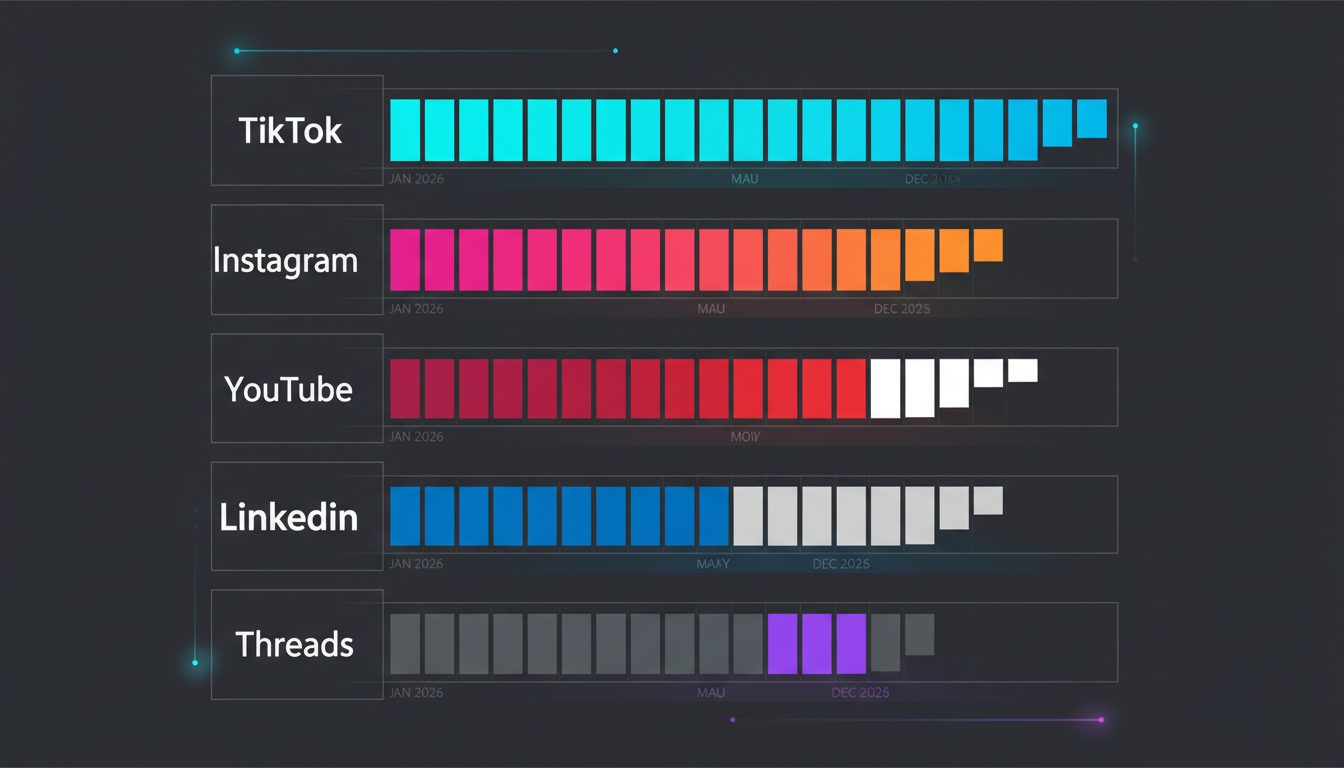
Short-form video is no longer just TikTok clips. In 2026, the format has matured into serialized storytelling, where creators release multi-part content designed to build returning viewers rather than chase one-off viral moments. Retention - not reach - has become the primary success metric.
According to Statista, short-form video accounts for 67% of all video consumed on mobile devices in 2026. That number has grown every year since 2020, and there is no sign of a plateau. But what has changed is how the best-performing creators use the format.
The Rise of Episodic Content
Brands like software companies, financial services firms, and even local businesses are producing serialized short-form series - think "3-part breakdowns" or "weekly teardowns" - that train their audience to come back. A viewer who returns for episode three is far more valuable than one who watches a single viral clip and moves on.
Hootsuite's benchmark data shows that accounts using serialized short-form content see 3.4x higher comment rates and 2.1x more profile visits per video compared to standalone clips. The reason is straightforward: serialized content builds expectation, and expectation drives habitual consumption.
Silent Video Is Still Dominant
One trend that has not changed: 85% of social videos are watched without sound (Instapage / Meta data, 2026). Subtitles, on-screen text, and visual storytelling are not optional add-ons. They are how your message actually reaches your audience. Any brand that is not captioning its video content is producing content that half its audience will never fully understand.
What Is Social Search and Why Does It Matter for Brands?
Social search refers to using platforms like TikTok, Instagram, YouTube, and Pinterest as search engines rather than just content feeds. For brands, it means that keyword strategy - long reserved for Google SEO - now applies directly to social media captions, hashtags, and spoken content in videos.
A 2026 Adobe study found that 42% of Gen Z users prefer TikTok or Instagram over Google for discovering new products, restaurants, and services. That number rises to 51% when the search is for something visual - recipes, fashion, travel destinations, home decor. If your social content is not optimized for search intent, you are invisible to a large and growing segment of buyers.
How to Optimize Social Content for Search
The mechanics are different from traditional SEO but the logic is the same: understand what your audience searches for, and make sure your content surfaces when they do.
- Use exact-match phrases in captions. Write captions the way people search, not the way copywriters write headlines. "Best running shoes for flat feet" beats "Find your perfect stride."
- Say the keyword out loud in videos. TikTok and YouTube both index spoken words. If you say your target keyword in the first 10 seconds of a video, it ranks better for that term.
- Add alt text and descriptive filenames to every image post. Instagram indexes alt text. Most brands skip this completely, which is a free SEO advantage left on the table.
- Use location tags for local discovery. Location-tagged posts receive 79% more engagement than non-tagged posts in local discovery searches (Sprout Social, 2026).
- Write the first line of your caption as a search query answer. Algorithms on both TikTok and Instagram now parse caption text for relevance signals.

How Are Social Media Algorithms Changing in 2026?
Algorithms in 2026 are rewarding content that generates conversation and keeps users on-platform, not content that sends them to external links. Every major platform has made this shift explicit, and it has significant implications for how brands structure their posts.
Here is a side-by-side view of how the major platform algorithms are currently weighted:
| Platform | Top Ranking Signal | Content Format Favored | Avg. Organic Reach |
|---|---|---|---|
| TikTok | Watch time & replays | Short-form video (under 60s) | ~18-22% |
| Saves & shares | Reels + Carousels | ~5-8% | |
| Comments in first 60 min | Text posts + native documents | ~10-15% | |
| Meaningful interactions | Video + Groups content | ~2-3% | |
| YouTube | Click-through rate + retention | Long-form + Shorts combo | Subscription-driven |
| Saves & close-up views | Vertical images + Idea Pins | ~20-30% (search-based) | |
| Threads | Reply engagement | Text threads + polls | ~12-18% |
The pattern across all platforms is clear: passive consumption signals (likes, views) are weighted less than active engagement signals (comments, saves, shares). Creating content that prompts a response - a question, a strong opinion, a useful save - is now more valuable than creating content that simply looks good.
Zero-Click Content: The Strategy Shift Nobody Talks About Enough
Zero-click content delivers complete value inside the post itself, with no link required. A how-to carousel that teaches the full skill. A caption that answers the full question. A video that leaves nothing unexplained. Platforms love this because users stay on-platform. Your audience loves it because they get instant value without an extra step.
LinkedIn data from early 2026 shows that posts without outbound links receive 3x more impressions than posts with links in the caption. Instagram has observed similar patterns. Moving your best information into the post itself - rather than hiding it behind a "link in bio" - is the single fastest change most brands can make to improve organic performance.
What Role Does Community Play in Social Media Growth Today?
Community-led growth has replaced follower-count-chasing as the dominant strategy for sustainable social media performance. An account with 5,000 engaged community members consistently outperforms one with 50,000 passive followers in every metric that actually drives business outcomes: conversions, referrals, and repeat buyers.
Sprout Social's 2026 research found that 68% of consumers say they are more likely to buy from a brand whose social community they actively participate in. This is not about building a forum - it is about creating consistent reasons for your audience to talk to you and to each other.
Practical Ways to Build Community on Social Platforms
- Reply to every comment in the first two hours after posting - early engagement signals boost distribution on every major algorithm.
- Ask a specific, answerable question in every caption. Vague prompts get ignored. "What is your biggest challenge with X?" gets responses.
- Feature audience content - screenshots of great comments, user testimonials, or community wins - at least once per week.
- Use LinkedIn newsletters, Instagram Broadcast Channels, or Facebook Groups to create a persistent conversation space separate from your main feed.
- Recognize loyal community members by name. People follow brands longer when they feel personally seen.
Tools like Brandlix make managing community interactions across multiple platforms practical - centralizing your inbox, comments, and mentions so nothing falls through the cracks when you are posting across eight or nine channels simultaneously.
How Is AI Changing Content Creation and Social Strategy?
AI is not replacing social media managers - it is eliminating the low-value work so they can focus on strategy and relationship-building. In 2026, 62% of marketing teams use AI tools at least weekly for content drafting, caption writing, or performance analysis (HubSpot, 2026). The question is no longer whether to use AI, but how to use it without producing generic content that sounds like everyone else.
The brands getting the most value from AI in social media are using it for three specific tasks:
- Content repurposing at scale. Taking a single long-form piece - a webinar, a blog post, a podcast episode - and generating platform-specific versions for each channel. This multiplies output without multiplying effort.
- Performance analysis and pattern recognition. AI tools can identify which content formats, posting times, and caption structures consistently perform best for a specific account, then surface those patterns faster than manual analysis allows.
- First-draft generation with human refinement. Using AI for the blank-page problem - generating a starting point - then editing heavily with brand voice and specific expertise. The output is faster and the final quality depends entirely on the editor's judgment.
What AI cannot replace is genuine expertise, lived experience, and the kind of specific industry knowledge that makes content actually trustworthy. The brands winning on social in 2026 are combining AI efficiency with human depth - not choosing one over the other.
The Authenticity Backlash
There is a counter-trend worth acknowledging: audiences are increasingly sensitive to content that feels entirely AI-generated. On platforms like LinkedIn, posts with specific personal anecdotes, concrete numbers from the author's own experience, and named individuals in the story outperform polished but generic AI-assisted posts by a significant margin. Authenticity signals have become a competitive advantage, not just a nice-to-have.
Which Emerging Platforms Should Brands Watch in 2026?
The platforms most worth watching in 2026 are Bluesky, Threads, and YouTube's continued push into short-form. Each represents a different bet on where social behavior is heading, and each rewards a different content approach.
Bluesky's decentralized architecture appeals to audiences who have grown frustrated with algorithmic manipulation. Its user base skews toward tech-literate, opinion-driven professionals - a valuable audience for B2B brands and thought leaders. The platform crossed 40 million users in Q1 2026 and is growing at roughly 8% month-over-month.
Threads has found its footing as a text-first platform for casual, opinion-based content. Engagement rates on Threads average 5.7% - higher than Twitter/X's current 3.1% benchmark (Socialinsider, 2026). For brands that have a strong written voice, Threads is now a legitimate primary channel, not just a secondary experiment.
- Bluesky: Best for tech, media, and professional services brands targeting early adopters.
- Threads: Best for brands with conversational, opinion-driven content and a strong existing Instagram following.
- YouTube Shorts: Best for brands already investing in long-form YouTube content and looking to feed new audiences into their main channel.
- Pinterest: Underrated for e-commerce and lifestyle brands - search-driven traffic with a 2-to-3-year content shelf life versus 24-48 hours on feed-based platforms.

How Should Brands Measure Social Media Performance in 2026?
Vanity metrics - follower counts, raw impressions, total likes - are losing relevance as measurement benchmarks. The metrics that correlate with actual business outcomes in 2026 are engagement rate, saves, shares, social-referred revenue, and community growth rate.
According to Hootsuite's 2026 Social Trends Report, 71% of marketers say proving social media ROI is their top priority, yet only 34% have a clear attribution model connecting social activity to revenue. That gap represents a major strategic vulnerability for most marketing teams.
A practical measurement framework for 2026 looks like this:
- Track engagement rate per post, not total likes. Engagement rate normalizes performance across different audience sizes and is a true indicator of content quality.
- Monitor saves and shares separately from likes. Saves indicate utility and future intent. Shares indicate advocacy. Both are stronger signals than a passive double-tap.
- Use UTM parameters on every link. Without UTMs, you cannot connect social traffic to conversions in your analytics platform.
- Measure community growth rate, not just community size. A community growing at 5% per month is more valuable than a stagnant community of 100,000.
- Track response time as a KPI. With 78% of consumers expecting responses within 24 hours, response time is now a customer experience metric, not just a social media metric.
Using a platform like Brandlix to centralize analytics across all 10 channels makes this kind of structured measurement practical for teams that do not have dedicated data analysts - you get a unified view of what is working without toggling between eight different native dashboards.
Frequently Asked Questions
Which social media platform has the highest organic reach in 2026?
TikTok and Pinterest currently offer the highest organic reach, averaging 18-22% and 20-30% respectively. TikTok rewards watch time and replays, while Pinterest benefits from its search-driven discovery model where content remains visible for months or years after posting - unlike feed-based platforms where posts expire within 24-48 hours.
Is short-form video still worth investing in for brands in 2026?
Yes. Short-form video accounts for 67% of all mobile video consumption in 2026 (Statista). The format has evolved toward serialized, episodic content rather than standalone viral clips. Brands that build returning viewers through multi-part series see significantly higher comment rates and profile visits than those chasing one-off viral moments.
What is zero-click content and why is it important?
Zero-click content delivers complete value inside the post without requiring the audience to click a link. LinkedIn posts without outbound links receive 3x more impressions than those with links. Since every major algorithm now rewards content that keeps users on-platform, embedding your best information directly in the post - rather than behind a "link in bio" - has become one of the most effective ways to improve organic reach.
How should small brands approach emerging platforms like Bluesky and Threads?
The safest approach is to test one emerging platform at a time, repurposing existing content rather than creating from scratch. Threads rewards conversational, opinion-based content with a 5.7% average engagement rate, while Bluesky suits tech-adjacent and professional services brands. Neither requires a major content investment to test - start with three posts per week for 60 days and evaluate retention and engagement before committing further resources.
Social media in 2026 rewards specificity over scale. Knowing your audience well enough to create content they save, share, and return for - across the platforms where they actually spend time - matters far more than posting volume or follower count. Pick the two or three trends from this list that are most relevant to your audience and channel mix, build a 60-day experiment around each one, and measure what actually moves the needle for your business.