Threads marketing is no longer an experiment. Since Meta's text-based platform crossed 300 million monthly active users (Meta, 2026), brands that ignored it are now playing catch-up. If you want to build a real audience on Threads - not just a placeholder profile - this guide walks you through everything: strategy, content formats, posting cadence, growth tactics, and how to measure what actually matters.
- Threads has surpassed 300 million monthly active users, making it a legitimate marketing channel in 2026
- Conversational, opinion-driven posts outperform polished brand copy on Threads by a wide margin
- The best posting frequency is 3-5 times per week, prioritizing quality over volume
- Threads does not have paid advertising yet - organic reach is the only game in town, which is an advantage for brands that move now
- Cross-posting from Twitter/X or LinkedIn word-for-word is one of the fastest ways to kill your Threads engagement
What Is Threads and Why Should Marketers Care About It?
Threads is Meta's text-first social platform, directly integrated with Instagram. It launched in mid-2023 and has grown faster than any other social app in the same time window. Marketers should care because the platform still offers organic reach that most established channels stopped providing years ago.
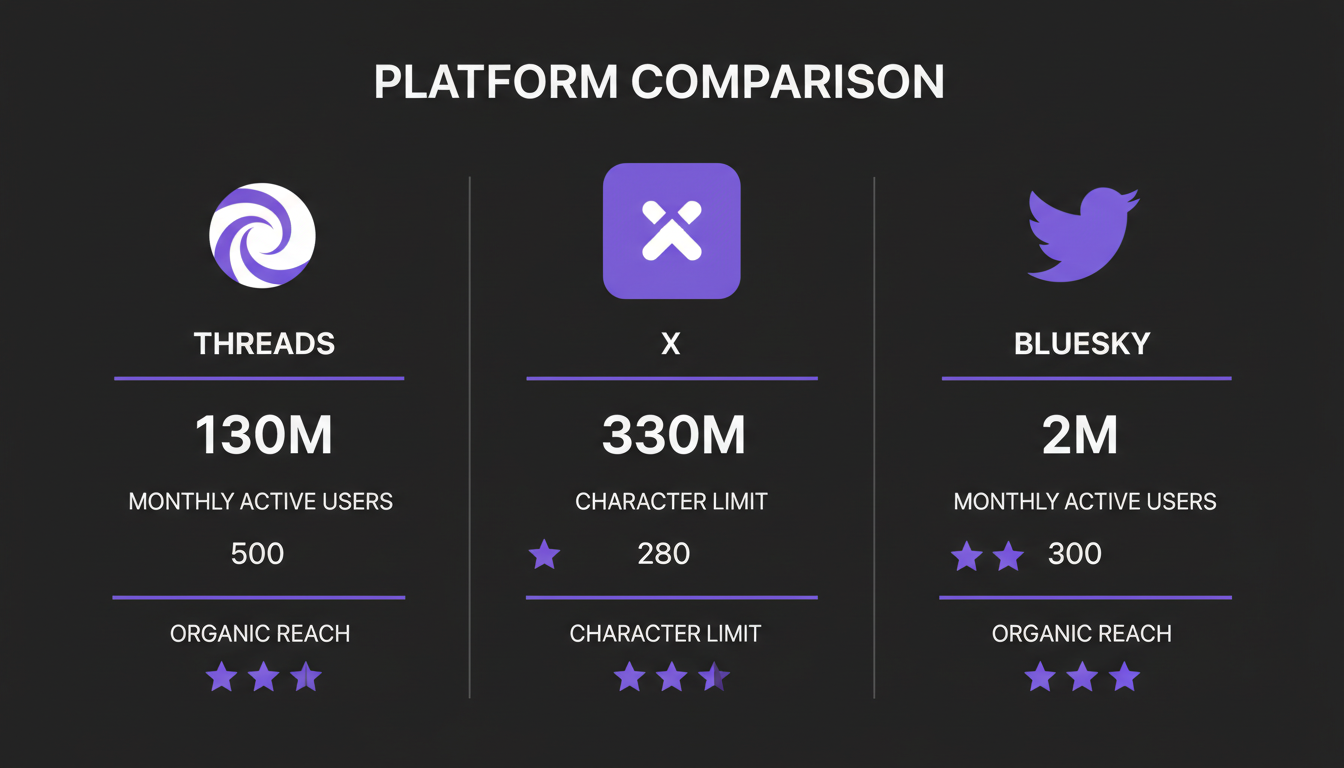
Unlike Instagram or Facebook, Threads does not yet run ads. That means every impression you earn is organic - no pay-to-play filter. According to Sprout Social's 2026 Index, organic reach on Threads averages 4.2% of followers per post, compared to under 2% on Facebook and roughly 3% on Instagram. That gap is significant.
The platform skews toward a younger, more engaged demographic. 62% of Threads users are between 18 and 34 (Statista, 2026). They expect brands to sound like people, not press releases. If your social voice is already conversational, Threads will feel like a natural extension. If it is not, this is a good reason to recalibrate.
How Threads Differs From Twitter/X and Mastodon
The comparison to Twitter/X is obvious, but the platforms behave differently in practice. Threads does not have a chronological feed as the default - its algorithm prioritizes content from accounts you do not yet follow, which creates discovery opportunities Twitter/X rarely provides to mid-sized accounts.
Mastodon is decentralized and fragmented. Threads is backed by Meta's infrastructure and its ActivityPub integration means future interoperability with the broader fediverse. For a marketer, that infrastructure matters: the audience is there, the tools are maturing, and the growth curve is still steep.
How Do You Build a Threads Marketing Strategy From Scratch?
Start with one clear goal, not five. Threads rewards consistency and clarity. Trying to do thought leadership, customer support, product promotion, and community building all at once will make your account feel scattered - and scattered accounts do not grow.
Here is a step-by-step framework to build your Threads marketing strategy:
- Define one primary objective - audience growth, brand awareness, website traffic, or community building. Pick the one that maps to your current business priority.
- Audit your existing social voice - read your last 20 posts on any platform. Does the tone sound human? Threads users will scroll past anything that feels corporate or templated.
- Research 5-10 competitors or peers in your niche - look at what types of posts they publish, which formats get replies, and how often they post. This is not about copying; it is about understanding baseline expectations.
- Create a simple content mix - a rough 60/30/10 split works well: 60% value-driven content (tips, opinions, insights), 30% conversation starters (questions, polls, replies), and 10% promotional content.
- Set up a posting schedule - commit to 3-5 posts per week minimum. Inconsistency is the fastest way to lose algorithmic favor on any platform.
- Connect your Instagram account properly - Threads is tied to Instagram, so make sure your bio, profile image, and handle are aligned across both. Cross-audience discoverability depends on this.
- Track one metric per objective - if your goal is awareness, track impressions. If it is community, track replies. Trying to watch ten metrics at once leads to analysis paralysis.
Setting Realistic Growth Expectations
Most brand accounts that post consistently on Threads see follower growth of 15-25% month-over-month during the first six months, provided they engage actively with replies and trending conversations. After that, growth tends to stabilize unless you make deliberate efforts to participate in larger discussions.
The accounts that grow fastest are not always the ones with the best content - they are the ones that reply the most. Threads is closer to a public conversation than a broadcast channel. Treat it that way.
What Content Formats Work Best on Threads?
Short text posts between 100 and 250 characters consistently earn the highest engagement rates on Threads. But format variety is what keeps an audience coming back. Relying on one content type, even if it works, creates a monotony that eventually flattens your numbers.
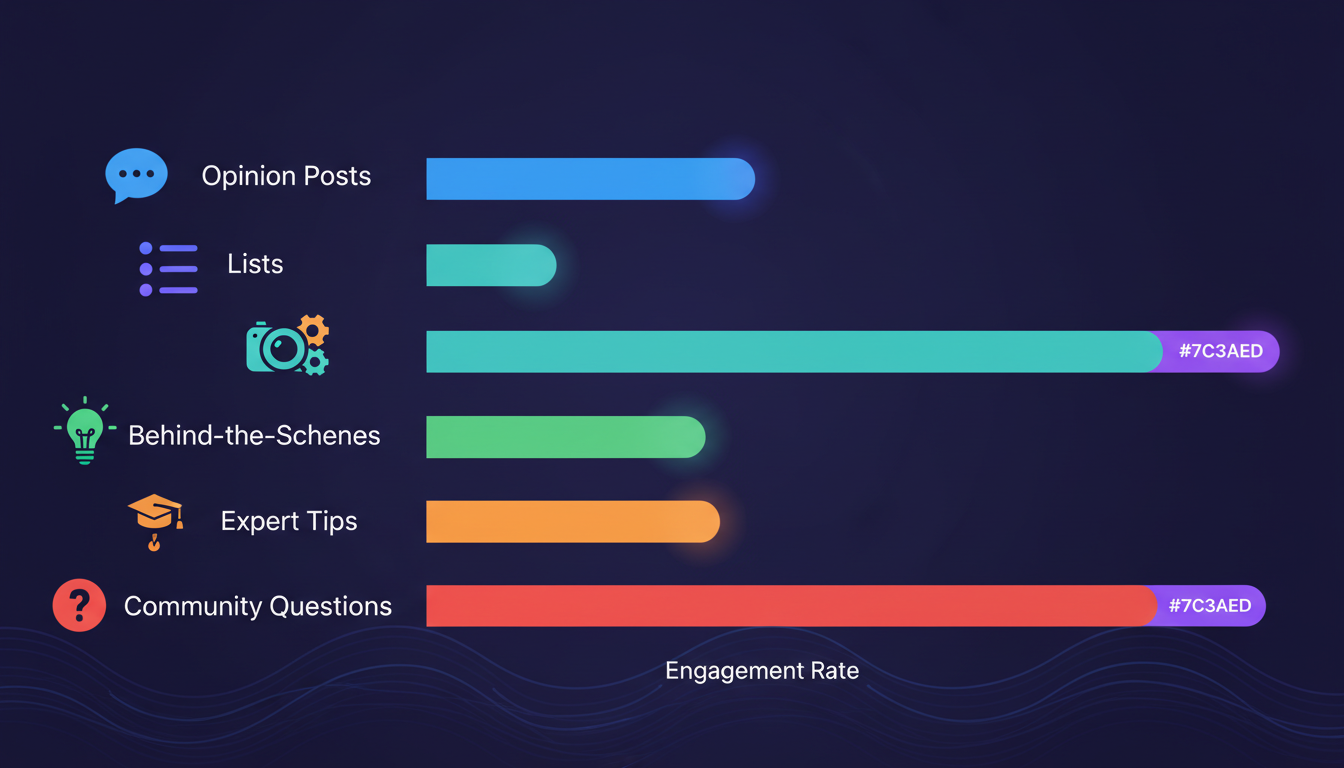
The highest-performing content formats on Threads, ranked by average engagement rate (Hootsuite Benchmark Report, 2026):
- Opinion posts - direct takes on industry topics or contrarian observations. Average engagement rate: 6.8%
- Question posts - open-ended questions that invite replies. Average engagement rate: 5.9%
- Short tips or frameworks - single actionable insights, not listicles. Average engagement rate: 5.4%
- Behind-the-scenes glimpses - what your team is working on, decisions you are making, honest admissions. Average engagement rate: 5.1%
- Image or video carousels - used sparingly. They perform well but require more production effort. Average engagement rate: 4.6%
- Re-shared Instagram Reels - the lowest average engagement at 2.3% when cross-posted without a text hook
Writing Posts That Actually Get Replies
Replies are the currency of Threads. The algorithm surfaces posts with active comment threads to a wider audience. So the goal of every post should not just be to inform - it should be to provoke a response.
A few techniques that reliably generate replies:
- End a statement with a direct question: "We switched to async meetings. Would your team ever try that?"
- Make a specific, debatable claim rather than a safe, agreeable observation
- Share a real failure or mistake, not a sanitized lesson
- Reference a trend or news item and add a specific perspective, not just a summary
What does not work: vague motivational statements, generic industry news with no opinion attached, and posts that start with "Exciting to announce." Those formats are trained patterns from older social media playbooks. Threads users see through them immediately.
When Is the Best Time to Post on Threads?
The peak engagement windows on Threads are Tuesday through Thursday, between 8-10am and 6-8pm in your primary audience's time zone. This data comes from Sprout Social's analysis of over 50,000 brand posts on Threads in early 2026. That said, time zone alignment matters more than a universal best time.
Here is a quick reference table for Threads posting times by audience region:
| Target Audience Region | Best Days | Best Time Windows | Avoid |
|---|---|---|---|
| North America (ET/CT) | Tue, Wed, Thu | 8-10am ET, 7-9pm ET | Saturday mornings, Sunday evenings |
| Western Europe (CET) | Mon, Tue, Thu | 7-9am CET, 5-7pm CET | Friday afternoons |
| Southeast Asia (SGT/ICT) | Mon, Wed, Fri | 8-11am SGT, 8-10pm SGT | Wednesday evenings |
| Middle East (GST/AST) | Sun, Mon, Tue | 9-11am GST, 6-8pm GST | Thursday afternoons |
| Latin America (BRT/COT) | Tue, Wed, Thu | 9-11am BRT, 7-9pm BRT | Monday mornings |
One important note: these windows are starting points, not rules. The only way to find your actual best time is to post at different hours for four to six weeks and compare engagement rates in your own analytics. Platform-level benchmarks are useful baselines, but your specific audience may behave differently.
How Often Should You Post on Threads?
Three to five posts per week is the sweet spot for most brand accounts. Posting daily can work, but only if you have genuine things to say. Low-quality daily posts will suppress your reach faster than posting three strong posts per week.
Using a scheduling tool that supports Threads - like Brandlix, which manages Threads alongside nine other platforms - makes it much easier to maintain a consistent cadence without bottlenecking everything through a single team member.
How Do You Grow a Threads Following Without Paid Ads?
Organic growth on Threads follows a fairly consistent pattern: accounts that engage with others grow three to four times faster than accounts that only broadcast their own content. This is not a soft recommendation - it is a measurable pattern visible in every public benchmark report for the platform.
The most effective organic growth tactics in order of impact:
- Reply to larger accounts in your niche - thoughtful replies on popular posts from accounts with 10,000+ followers expose you to their audience. Aim for 5-10 genuine replies per day during your growth phase.
- Participate in trending conversations early - Threads surfaces trending topics in the Explore tab. Jumping into a conversation within the first two hours of it trending significantly increases your visibility window.
- Cross-promote your Threads profile on Instagram Stories - since the two platforms share an account infrastructure, your Instagram audience is the fastest source of early followers. A weekly "follow us on Threads" story keeps new Instagram followers aware of your presence there.
- Collaborate with complementary accounts - co-author threads, tag each other in relevant posts, or agree to reply to each other's discussion-starter posts. This is the Threads equivalent of a guest blog post.
- Post thread chains strategically - a multi-post thread (where you reply to your own first post to add more content) keeps people on your profile longer and signals engagement depth to the algorithm.
- Use your Threads link in email newsletters - email subscribers are high-intent followers. A brief mention of your Threads account in your newsletter drives followers who are already warm to your brand.
According to HubSpot's 2026 Social Media Report, brands that combine at least three of these tactics simultaneously grow their Threads following 2.7 times faster than brands using only one tactic. Stacking strategies is not optional - it is what separates slow accounts from fast-growing ones.
How Do You Measure Threads Marketing Performance?
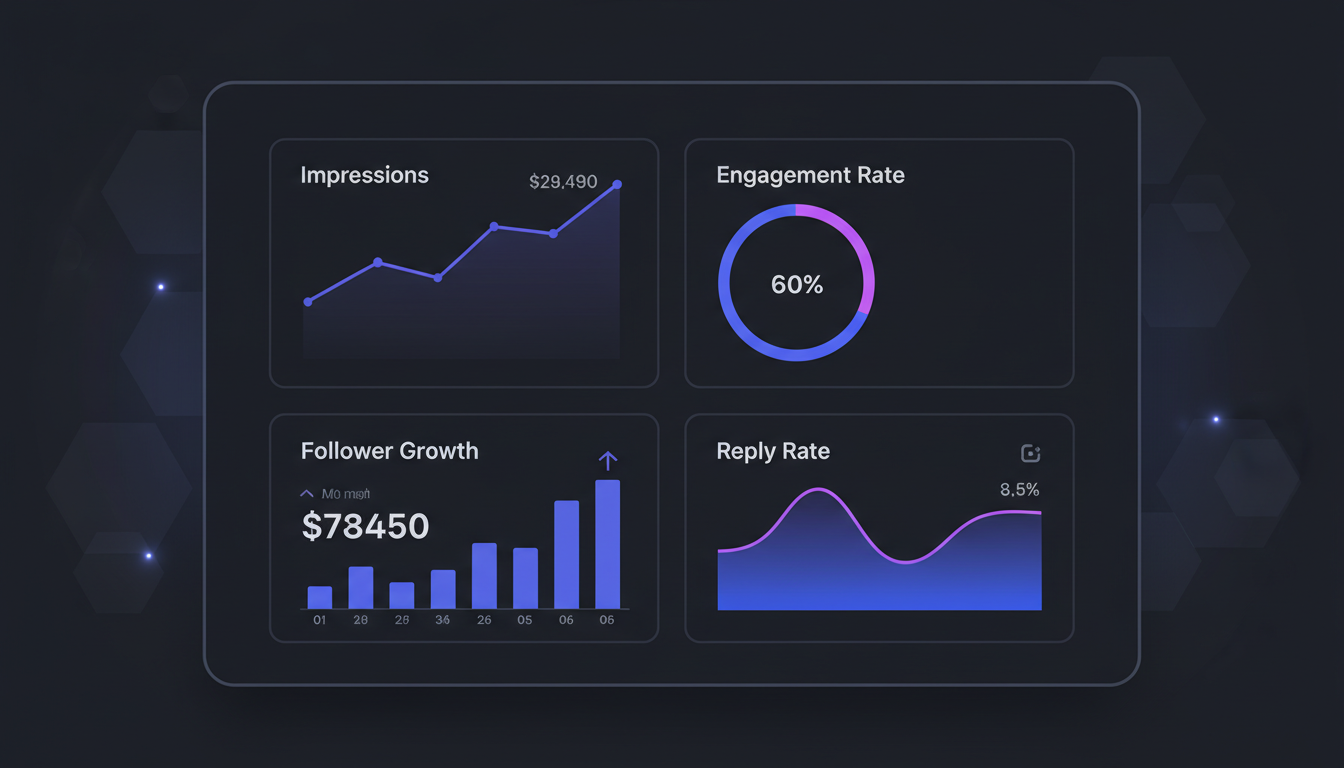
Threads provides native analytics within the app. The metrics that matter most depend on your stated objective, but there are four core indicators every brand should track regardless of goal. Tracking everything at once produces noise; tracking the right four produces direction.
The four core Threads metrics every marketer should monitor:
- Impressions - total number of times your posts were seen. This is your reach indicator. If impressions are stagnant while followers grow, your content is losing algorithmic favor.
- Replies - the primary engagement signal the Threads algorithm uses to decide whether to amplify your content. More important than likes in this context.
- Profile visits per post - this tells you how many people were curious enough to click through after seeing a specific post. High profile visits on a post means the hook worked.
- Follower growth rate - track this weekly, not daily. Daily fluctuations are noise. Weekly trends show you whether your overall strategy is pulling people in or pushing them away.
What Benchmarks Should You Aim For?
For a brand account in the 1,000-10,000 follower range, a 3-5% reply rate per post is a healthy benchmark. Accounts above 50,000 followers typically see lower reply rates (around 1-2%) simply due to scale. Do not compare your reply rate to a mega-account's numbers - it is not an apples-to-apples comparison.
Impressions-to-follower ratio is another useful benchmark. If you regularly earn impressions equal to 60-80% of your follower count per post, the algorithm is actively distributing your content beyond your existing audience. Below 40% and you are mostly talking to people who already know you.
What Are the Most Common Threads Marketing Mistakes?
The most common mistake is treating Threads like a cross-posting destination. Brands that auto-publish their LinkedIn announcements or Twitter/X updates to Threads without any adaptation see engagement rates 73% lower than brands that write natively for the platform (Hootsuite, 2026). The platform has its own culture, and audiences detect recycled content immediately.
Other frequent mistakes that hold brands back:
- Only posting promotional content - if every post links back to a product page or blog post, your audience will stop paying attention. The 60/30/10 rule exists for a reason.
- Ignoring replies - not responding to comments on your own posts is the social media equivalent of hanging up on a customer. It also signals low engagement to the algorithm.
- Inconsistent voice - switching between formal and casual tones, or between personal and corporate perspectives, confuses followers about what your account actually represents.
- Deleting underperforming posts - a post that does not get traction in the first hour is not necessarily dead. Threads surfaces older content differently than Twitter/X. Deleting quickly removes any chance of delayed discovery.
- Over-hashtagging - Threads does not use hashtags the way Instagram does. Heavy hashtagging looks spammy and does not improve discoverability in the same way.
- Waiting for perfection - Threads rewards volume and responsiveness. A good post published today beats a perfect post published next week every single time.
How Does Threads Fit Into a Multi-Platform Social Strategy?
Threads works best as a conversation layer in a broader content ecosystem. It is not where you put your long-form video, your product photography, or your tutorial content. Those belong on YouTube, Instagram, and TikTok respectively. Threads is where you show the thinking behind the content, the opinions that did not fit into the caption, and the questions you are genuinely asking your audience.
Think of it this way: if Instagram is the highlight reel, Threads is the conversation happening in the comments section - except you control the framing. That positioning makes it a natural complement to almost every other platform, not a competitor.
Platforms like Brandlix make it practical to manage Threads alongside your other channels in one workflow, which removes the friction that causes most brands to deprioritize it. The barrier is rarely strategy; it is usually time and tooling.
One important cross-platform note: content that works on LinkedIn rarely translates well to Threads without significant rewriting. LinkedIn favors structured insight posts with clear professional framing. Threads favors raw, slightly unfinished thinking that invites someone else to add their perspective. The underlying idea can be the same - the packaging needs to change completely.
Frequently Asked Questions
Does Threads have advertising options for brands?
As of 2026, Threads does not have a self-serve advertising platform. Meta has confirmed that paid ads are in development, but brands currently have access to organic reach only. This actually benefits early movers - organic impressions are available at a scale that will likely decrease once ads arrive and competition increases.
How long should a Threads post be?
Threads allows up to 500 characters per post. The highest-engagement posts tend to be between 100 and 250 characters - short enough to read instantly, long enough to convey a complete thought. For thread chains (multi-post replies to yourself), each individual post can be shorter, but the chain as a whole should lead somewhere meaningful rather than padding out a simple idea.
Can you schedule Threads posts in advance?
Yes. Meta's native Creator Studio supports basic scheduling for Threads, and third-party social media management platforms that have integrated the Threads API offer more flexible scheduling options. Planning posts in advance makes it much easier to maintain a consistent 3-5 posts per week cadence without relying on daily manual publishing.
Is Threads worth it for B2B brands, or is it mainly B2C?
Threads is viable for both, but the approach differs. B2C brands tend to focus on brand personality, product stories, and community questions. B2B brands that perform well on Threads typically lead with sharp industry opinions, honest observations about their sector, and genuine expertise - not product announcements. If your B2B content strategy already emphasizes thought leadership, Threads is a strong fit.
Threads in 2026 is past the "should we be there?" stage. The platform has the users, the engagement rates, and the organic reach that most channels stopped offering long ago. The brands building real audiences there right now are doing it with consistent posting, genuine conversation, and content that fits the platform's culture instead of fighting it. That is not a complicated formula - it just requires showing up with something real to say. Start with one post this week, reply to five accounts in your niche, and measure what happens. The results will tell you the rest.