A solid YouTube Shorts strategy is no longer optional for creators and brands that want to grow on YouTube. Shorts now generate over 70 billion daily views (YouTube, 2026), making the format one of the most-watched short video surfaces on the internet. Whether you're starting from zero or trying to break through a growth plateau, this guide walks you through exactly what works.
- YouTube Shorts reaches 70 billion daily views - ignoring it means leaving massive organic reach on the table.
- The first 2-3 seconds of a Short determine whether viewers swipe away or keep watching.
- Posting 3-5 Shorts per week consistently outperforms sporadic high-effort uploads.
- Shorts and long-form videos work together - a strong Shorts presence drives subscribers who then watch your longer content.
- Using chapters, keywords in titles, and on-screen text together dramatically improves discoverability.
What exactly is a YouTube Shorts strategy and why does it matter?
A YouTube Shorts strategy is a structured plan for creating, publishing, and optimizing vertical short-form videos (up to 3 minutes) to achieve specific channel goals. Without a strategy, most creators treat Shorts as throwaway content - and get throwaway results.
The data tells a different story for those who are intentional. Channels that publish Shorts consistently see 3x faster subscriber growth compared to channels that publish only long-form content, according to a 2026 Hootsuite benchmark report. That's not because Shorts are magic - it's because they compress your feedback loop. You can test 10 hooks, topics, or formats in 10 days instead of 10 weeks.
For brands, the stakes are even higher. 53% of Gen Z users discover new brands through short video platforms (Statista, 2026), and YouTube Shorts sits directly inside the same app where those users already watch tutorials, reviews, and long-form entertainment. Discovery and conversion happen in one place.
How Shorts differ from TikTok and Instagram Reels
All three formats are vertical and short, but the audiences and algorithms behave differently. YouTube Shorts benefits from YouTube's search infrastructure - your Short can rank for a keyword query months after publishing, something that rarely happens on TikTok or Reels. That makes SEO-informed Shorts a compounding asset rather than a one-time traffic spike.
YouTube also gives Shorts a dedicated shelf on every channel page and pushes them to non-subscribers through the Shorts feed. A single well-performing Short can expose your channel to an audience that would never find you through search alone.
How do you build a YouTube Shorts content strategy from scratch?
Start by defining one clear goal per phase: subscriber growth, product awareness, or traffic to long-form content. Trying to accomplish all three at once dilutes your focus and makes it harder to measure what's working.
- Define your niche and target viewer. Write one sentence describing exactly who you're making Shorts for and what problem you solve for them. Vague niches produce vague content.
- Audit what already works on your channel. If you have existing long-form videos, check which ones have the highest click-through rate and average view duration. Those topics are already proven - repurpose their core ideas into Shorts first.
- Research competitor Shorts. Sort competitors' channels by "Popular" and filter for Shorts. Look at view counts, hook structures, and comment sentiment. You're not copying - you're identifying what the audience actually wants.
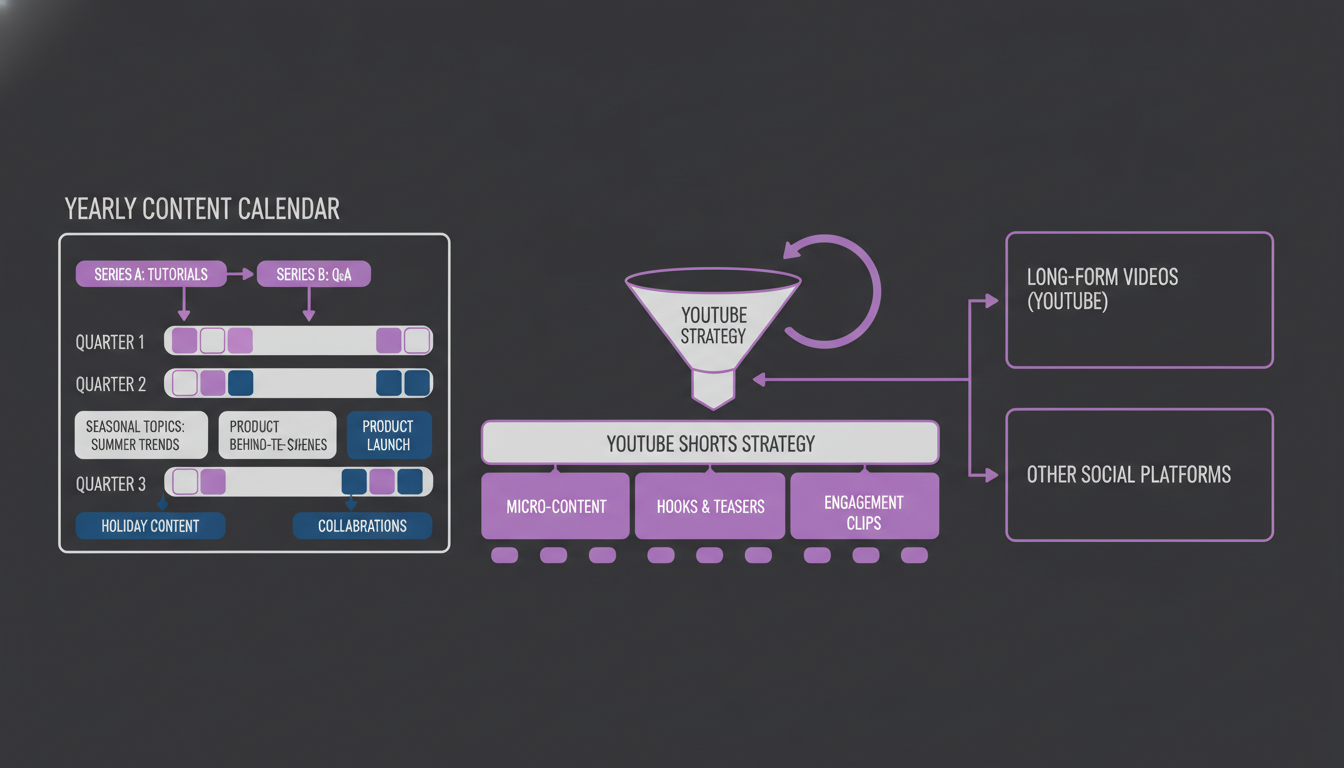
- Map a 30-day content calendar. Plan at least 3 Shorts per week with defined topics. Leave room for reactive or trending content, but anchor your calendar to evergreen ideas that serve your niche year-round.
- Set a production workflow. Shorts should be fast to produce. Aim for a maximum of 60-90 minutes of production time per Short, including filming, editing, and upload. If it takes longer, simplify your format.
- Define your metrics. For growth, watch subscriber conversion rate per Short. For awareness, track views and unique viewers. For traffic, track how many Shorts viewers visit your channel page and click to long-form videos.
What makes a YouTube Short actually perform well?
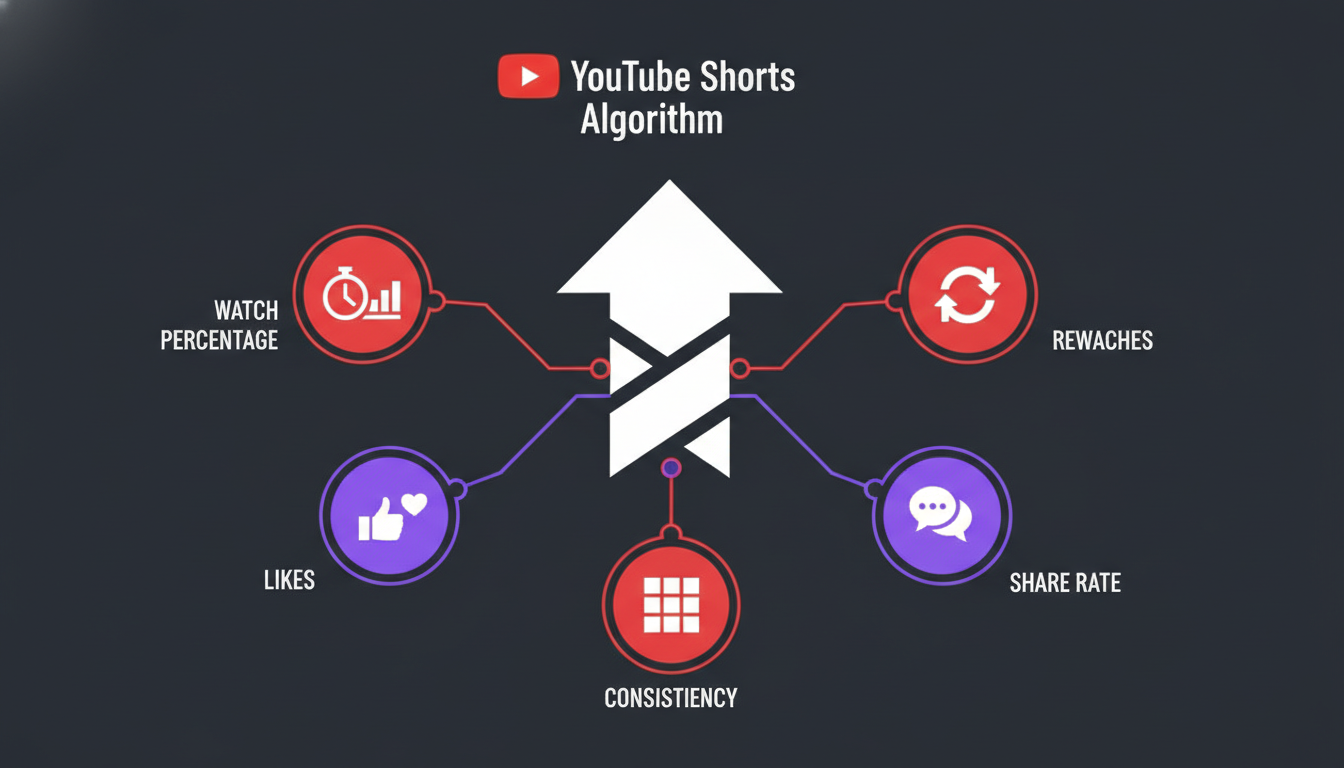
The single biggest performance driver is the hook - the first 2-3 seconds. If viewers swipe past before the third second, the algorithm registers low audience retention and stops distributing your Short. Everything else - editing, audio, call-to-action - only matters if your hook earns the next few seconds.
Hook formulas that consistently work
- The bold claim: State something counterintuitive or surprising immediately. "Most brands waste their biggest marketing asset."
- The direct question: Ask the viewer something they care about answering. "Are you posting at the wrong time every single day?"
- The visual disruption: Start mid-action, not with a logo or introduction. Movement on screen in the first frame stops the scroll.
- The number hook: "Five things I wish I knew before hitting 100k subscribers" - numbers create an immediate promise of structured value.
The role of retention curves
YouTube's internal data shows that Shorts with above-average audience retention receive significantly higher distribution in the Shorts feed. Aim for at least 70% average view duration on your best-performing Shorts. You can see this in YouTube Studio under "Shorts" analytics. If a Short drops off sharply at the 8-second mark, something in the first third is losing viewers - usually a slow setup or a hook that doesn't match the thumbnail's implied promise.
Keep your on-screen text tight. Research from Sprout Social (2026) shows that Shorts with readable text overlays see a 22% higher completion rate than those relying solely on voiceover. Subtitles are not just an accessibility feature - they're a retention tool for viewers watching without sound.
How often should you post YouTube Shorts for maximum growth?
For most channels, 3-5 Shorts per week is the optimal publishing cadence. This is frequent enough to feed the algorithm's preference for active channels, but manageable enough to maintain quality. Posting daily without a quality floor tends to hurt channel metrics over time.
| Posting Frequency | Typical Monthly Views Range | Subscriber Growth Rate | Best For |
|---|---|---|---|
| 1-2 Shorts/week | Low to moderate | Slow | Channels prioritizing long-form |
| 3-5 Shorts/week | Moderate to high | Consistent | Most brands and creators |
| Daily (7/week) | High potential, high variance | Fast if quality holds | Dedicated Shorts-first creators |
| Burst posting (10+ in a week, then pause) | Unpredictable | Inconsistent | Not recommended |
Consistency matters more than volume. A channel publishing 4 Shorts every week for 3 months builds a stronger algorithmic track record than one that publishes 20 in a single week and then goes quiet. YouTube's recommendation system rewards sustained activity over short-term bursts.
Timing also plays a role. According to HubSpot's 2026 Social Media Trends report, YouTube content published between 12 PM and 3 PM on weekdays tends to receive the highest initial engagement velocity, which influences how aggressively the algorithm distributes a Short in its first 48 hours.
How do you optimize YouTube Shorts for search and discovery?
YouTube Shorts are indexed by YouTube's search engine the same way long-form videos are. Using relevant keywords in your title, description, and spoken audio gives your Short a long tail of discoverability that extends well beyond the initial Shorts feed push.
Title and description best practices
- Keep titles under 60 characters - they truncate in the Shorts feed on mobile.
- Put your primary keyword within the first 5 words of the title.
- Write descriptions of at least 150 words with natural keyword usage - many creators leave the description empty, which is a missed SEO opportunity.
- Use 3-5 relevant hashtags, including at least one broad category hashtag and one niche-specific hashtag.
Audio SEO - a channel most creators ignore
YouTube automatically generates transcripts for Shorts, just like long-form videos. If you say your target keyword clearly in the video, it appears in the transcript, which YouTube uses for indexing. This is especially valuable for how-to and tutorial Shorts where viewers search for specific solutions. Saying "here's how to grow on YouTube Shorts in 2026" at the start of your Short is both a hook and a keyword signal.
Thumbnail selection also matters more than most creators realize. YouTube lets you choose a custom thumbnail for Shorts that appears when the Short is discovered via search results or recommended in the home feed. A high-contrast thumbnail with a readable text overlay can lift click-through rate by up to 35% compared to an auto-selected frame (Hootsuite, 2026).
How should you use YouTube Shorts alongside long-form video content?
The most effective YouTube channels in 2026 treat Shorts and long-form as a two-part funnel, not competing formats. Shorts bring in new viewers; long-form content converts them into loyal subscribers and customers. Neither format performs as well in isolation.
A practical approach: for every long-form video you publish, extract one or two 30-60 second highlight clips and release them as Shorts in the days before or after the main video. This creates a content multiplier effect - one hour of filming produces both a 10-minute video and 2-3 Shorts, driving traffic back to each other.
The Shorts-to-long-form conversion tactic
- End your Short with an open loop - pose a question or tease a deeper insight you cover in a long-form video.
- Pin a comment linking to the related long-form video (direct links in Shorts descriptions are often buried).
- Use the "Related video" feature in YouTube Studio to connect your Short to its parent long-form video.
- Track "Shorts viewers who also watched long-form content" in your analytics - this is the clearest signal that your funnel is working.
Channels that successfully connect Shorts to long-form content see 40% higher subscriber retention rates at the 90-day mark compared to channels running either format in isolation (Sprout Social, 2026). That gap exists because subscribers who found you through Shorts and then watched a long-form video have a much stronger sense of who you are and why they should stay.
What tools and workflows make YouTube Shorts production scalable?
Scalable Shorts production comes from standardized formats, not from working faster. When you have 3-4 repeatable Short formats defined, you stop making decisions about structure every time you sit down to create - you just execute.
Repeatable Short formats worth building
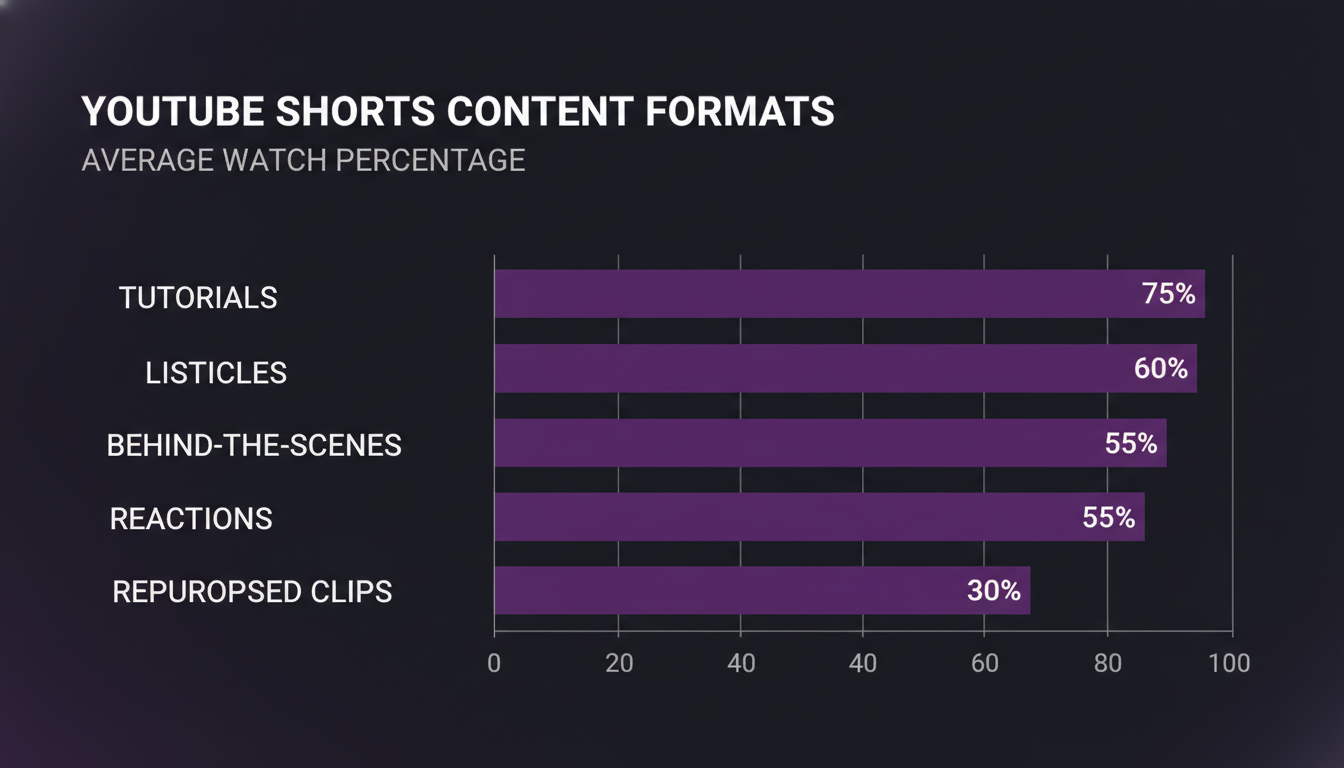
- The quick tip: One actionable insight, 30-45 seconds, consistent intro phrase. Easy to batch-film 5 at a time.
- The reaction or commentary: You respond to a trending topic or news item in your niche. Fast to produce, high relevance signal for the algorithm.
- The before/after: Show a transformation or contrast visually. Strong retention because viewers want to see the payoff.
- The repurposed clip: A clipped highlight from a podcast, interview, or long-form video. Minimal extra production time.
Scheduling and publishing at scale
Batching production sessions - filming multiple Shorts in one sitting - is the most effective way to maintain consistency without burning out. Pair that with a scheduling tool and you remove the daily decision of "should I post today." Platforms like Brandlix let you schedule Shorts alongside content for other platforms in a single workflow, which is particularly useful if your brand repurposes content across YouTube, TikTok, and Instagram simultaneously.
According to a 2026 Content Marketing Institute survey, brands that batch-produce short video content report 58% less time spent per video and a 41% higher weekly publishing frequency compared to brands that produce each video individually. The math is straightforward: batching works.
How do you measure whether your YouTube Shorts strategy is working?
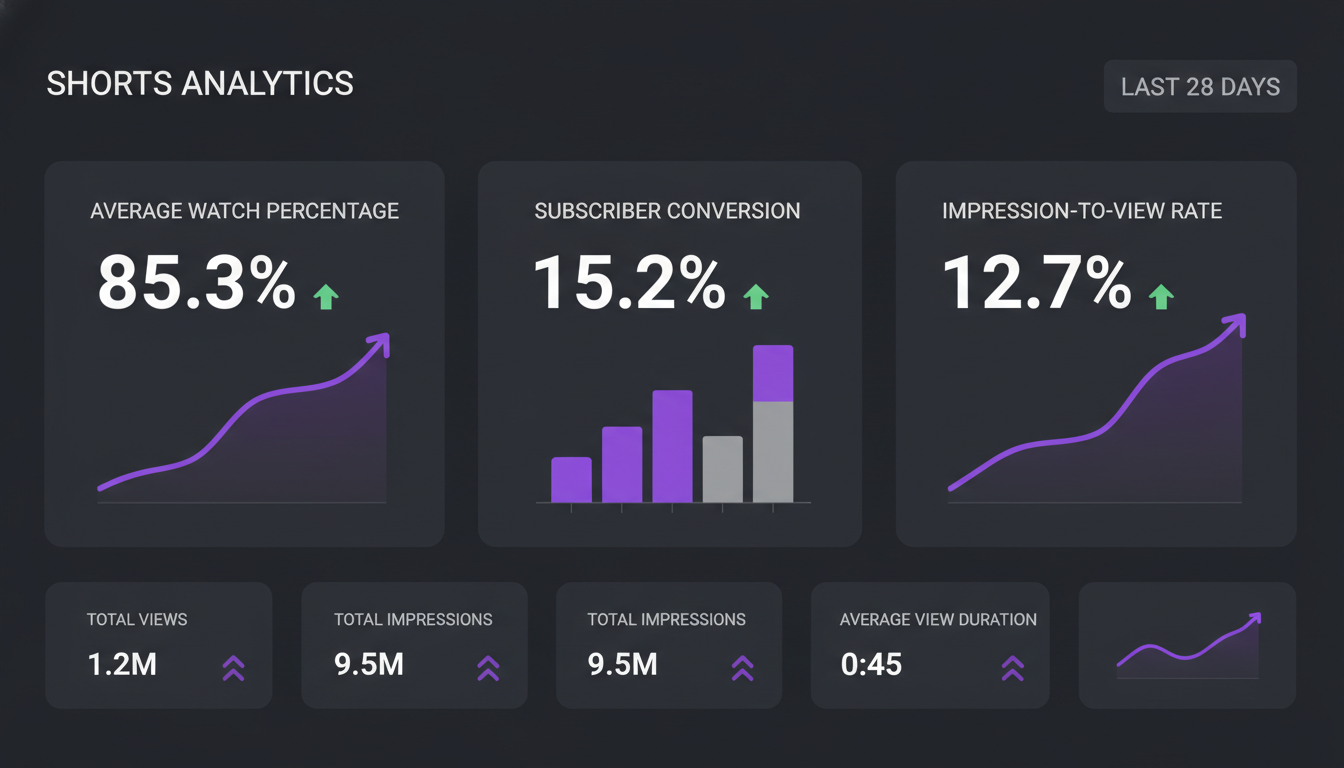
The metrics that matter depend on your goal, but four numbers give you a complete picture of Shorts performance: views, average view duration percentage, subscriber conversion rate, and channel page visits from Shorts.
Key Shorts metrics and what they tell you
- Average view duration (%): Below 50% means your hook or pacing is losing viewers early. Above 70% is strong. Above 90% suggests you have a format worth repeating immediately.
- Subscriber conversion rate: How many viewers subscribe after watching a Short. Industry average is roughly 0.5-1.5% per Short view (HubSpot, 2026). Exceeding 2% means your content-to-audience fit is strong.
- Shares: Shares are the strongest signal of resonance. A Short that gets shared moves beyond your existing audience organically - that's earned distribution.
- Comments: Qualitative signal. Comments tell you what your audience actually thinks, what questions they have, and what follow-up Shorts to make next.
Review your Shorts analytics once per week, not daily. Daily checking creates noise-driven decisions. Weekly review lets you spot real patterns - which topics retain viewers, which hooks generate shares, which publishing times correlate with higher initial view velocity. After 90 days of consistent publishing, you'll have enough data to double down on what's working and cut what isn't.
Frequently Asked Questions
Does posting YouTube Shorts hurt your long-form video performance?
No - when done correctly, Shorts actually support long-form performance. YouTube's algorithm treats Shorts and long-form content as separate surfaces, so a poorly performing Short does not suppress your long-form video recommendations. In fact, channels that maintain both formats see stronger overall subscriber growth because they attract viewers through two separate discovery paths.
What is the ideal length for a YouTube Short in 2026?
YouTube allows Shorts up to 3 minutes, but data consistently shows that Shorts between 30 and 60 seconds generate the highest average view duration percentages. For content that genuinely needs more time - detailed tutorials or multi-step explanations - 90 seconds to 2 minutes is acceptable. Anything beyond 2 minutes should probably be a regular vertical video or a traditional YouTube video instead.
Can you monetize YouTube Shorts and how much does it pay?
Yes. YouTube's Shorts monetization program shares ad revenue with creators who meet eligibility requirements: 500 subscribers, 3 public uploads in 90 days, and either 3,000 watch hours on long-form content or 3 million Shorts views in 90 days. Revenue per 1,000 Shorts views (RPM) is typically lower than long-form RPM, ranging from $0.03 to $0.08 per 1,000 views, but high view volumes can make Shorts a meaningful income stream on top of subscriber growth benefits.
How long does it take to see results from a YouTube Shorts strategy?
Most channels see measurable improvement in reach and subscriber growth within 60-90 days of consistent posting at 3-5 Shorts per week. The first 30 days are typically a data-gathering phase where the algorithm learns what your content is about and who to show it to. Channels that quit before the 90-day mark usually do so right before the point where compounding starts to kick in.
Putting your YouTube Shorts strategy into action
A strong YouTube Shorts strategy is not about volume or trending sounds - it's about clarity of purpose, consistent execution, and using data to improve over time. Start with one goal, define 2-3 repeatable formats, post at least 3 times per week, and review your analytics every 7 days. The channels that win on Shorts are almost never the ones with the biggest budgets. They're the ones that show up consistently and iterate quickly. If you're managing Shorts alongside other platforms, tools like Brandlix can help you keep your publishing schedule organized without the back-and-forth of manual uploads. But the strategy itself starts with knowing exactly who you're making content for and what you want them to do next.