Content repurposing means turning a single piece of content into multiple formats for different platforms, instead of producing completely new content for every channel. Anyone who wants to stay active on several social networks regularly can hardly avoid this principle. It saves time, increases reach, and makes sure a good idea does not get used just once.
- A blog article can be split into 8-12 individual social media posts without losing quality.
- Teams that systematically reuse content save a noticeable share of production time each month.
- Video content can be broken down into text, audio, carousels, and short clips, giving every platform a matching format.
- A clear repurposing workflow with a content calendar prevents duplicate work and format chaos.
- AI tools like Brandlix help automatically adapt content to platform formats and schedule it.
What exactly is content repurposing?
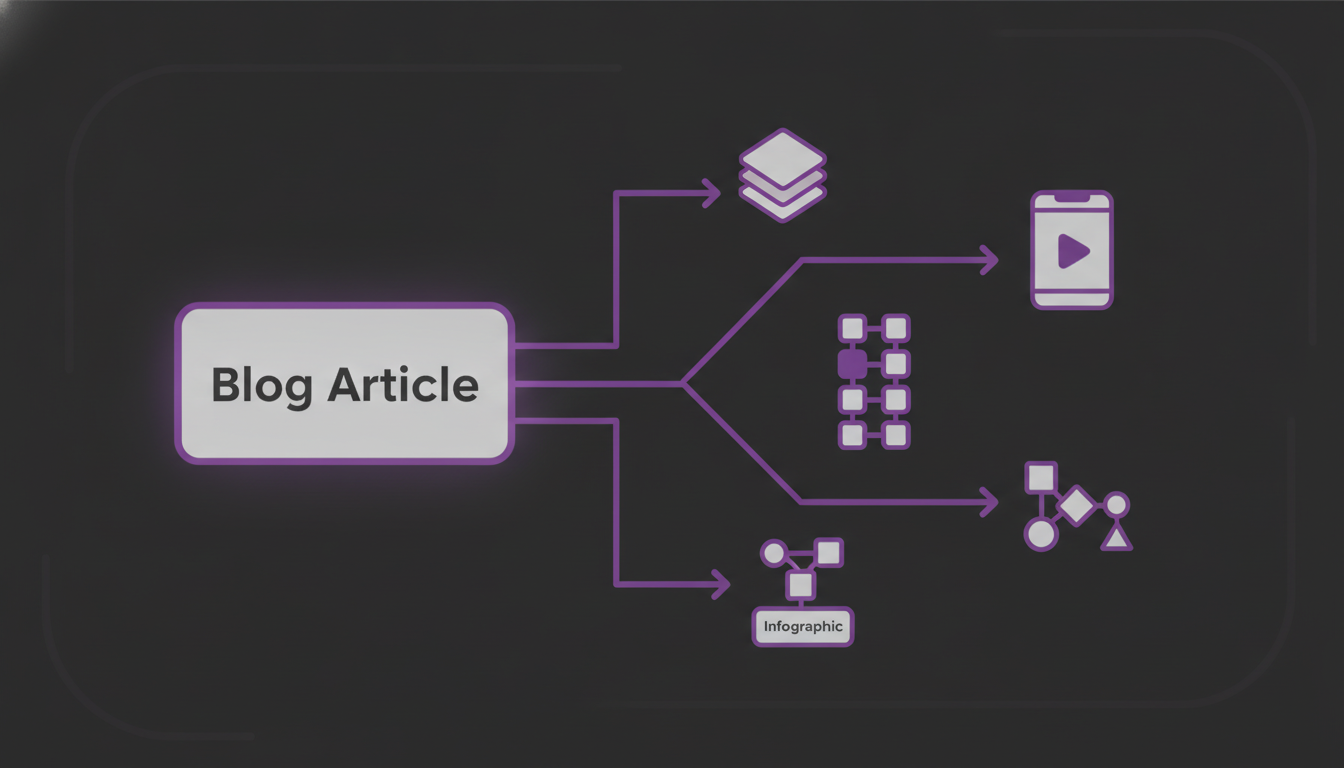
Content repurposing is the practice of transferring existing content into new formats, lengths, or channels to multiply its reach. A 1,500-word blog article, for example, becomes a LinkedIn post, a Twitter/X thread, an Instagram carousel, and a YouTube Short. The core content stays the same, only the packaging changes.
The principle is not new. Publishers were already turning newspaper articles into radio segments or book chapters decades ago. What is new is how many digital channels have to be served at once today. If you want a presence on 10 platforms, you cannot start from zero for each one individually.
- A webinar becomes 5 short video clips for TikTok and Reels.
- A customer case study becomes a LinkedIn article and a Pinterest infographic.
- A podcast interview becomes a blog article, several quote graphics, and a Twitter thread.
Why does content repurposing really pay off?
Content repurposing pays off because it saves production time, spreads reach across different audience segments, and increases the consistency of the brand message. Instead of inventing completely new ideas every week, you work with one solid core piece that gets used multiple times.
Marketing teams that work with a repurposing approach often report significantly more published posts per week without growing the team. That is because the most time-consuming part, research, storyline, core message, only happens once.
| Benefit | Without Repurposing | With Repurposing |
|---|---|---|
| Time spent per week | high, everything created from scratch | lower, mostly adapting |
| Number of platforms you can cover | 2-3 realistically | 6-10 realistically |
| Message consistency | varies day to day | stays stable across every channel |
| Running out of ideas | a frequent problem | rare, since one topic is enough |
| Content lifespan | one post, one moment | one topic, visible for several weeks |
A well-planned repurposing strategy turns a single idea into weeks of content, and that is exactly what separates an overloaded one-person team from a channel that still posts consistently.
How do you break one piece of content into multiple formats?
You break down a piece of content by first identifying the core statements, then translating each one into the right format for each platform. It is a process, not guesswork. Here is a proven approach:
- Choose an "anchor format," usually a long blog article, a webinar, or an in-depth video.
- Extract 5 to 8 individual core statements or quotes from the anchor content.
- Match each core statement to a suitable short format (quote graphic, carousel slide, tweet, short clip).
- Adjust tone and length per platform, LinkedIn handles more text than Twitter/X.
- Create visual assets once in several sizes (square, portrait, landscape).
- Schedule the formats spread across several weeks in the content calendar.
- Measure the performance of each format and adjust the next repurposing round accordingly.
Important: not every format fits every platform. A 10-minute YouTube video needs a radically shortened version on TikTok with a different opening in the first 3 seconds.
Example Matrix: One Blog Article Becomes 8 Formats
- A LinkedIn post with the 3 most important takeaways
- A Twitter/X thread with 6 to 8 tweets
- An Instagram carousel with 8 slides
- A Pinterest pin with an infographic summary
- A TikTok/Reel with a 30-second explanation
- A Facebook post with a discussion question
- A newsletter snippet linking to the full text
- A Threads post with a provocative claim from the article
Which formats work for which platform?
Every platform has its own preferences for format and length, and repurposing only works if you respect those differences instead of posting the same thing everywhere. A 1:1 copy-paste across every channel feels careless and algorithms often distribute it less.
| Platform | Preferred Format | Ideal Length |
|---|---|---|
| Carousel, Reel | 8-10 slides / 15-30 sec. | |
| Text post with paragraphs, document post | 800-1300 characters | |
| TikTok | Short video with a hook | 15-45 sec. |
| Twitter/X | Thread | 5-10 tweets |
| Vertical graphic/infographic | 1000x1500 px | |
| YouTube | Long-form or Shorts | 3-10 min. / up to 3 min. |
| Text + image, question to the community | 100-250 words | |
| Threads | Short opinion post | 1-3 sentences |
A content calendar keeps you on top of which format runs where and when, instead of losing track across 10 channels.

How do you build a repeatable repurposing workflow?
A repeatable workflow emerges once you treat repurposing not as a one-off action but as a fixed part of your monthly editorial plan. Without a system, the time saved evaporates because you rethink from scratch every time what becomes of which content.
- Set 2 to 4 anchor pieces per month (for example, a blog article, a webinar).
- Define standard formats that you derive from every anchor piece.
- Use templates for carousels, quote graphics, and thread structure so creation goes quickly.
- Schedule all derived formats in advance for 3 to 4 weeks.
- Analyze after 30 days which formats performed best.
Teams that run this cycle consistently can publish considerably more posts with only a slight increase in time spent. The reason: the heavy creative lifting happens once, and adaptation after that is pure routine.
This is exactly where Brandlix as an AI social media agent comes in: you upload an anchor piece, and the AI suggests matching formats for each of the 10 platforms, instead of you having to write every format manually from scratch.
Common Mistakes in Repurposing
- Posting the same text on every channel without adaptation.
- Trying to produce too many formats at once and lowering quality as a result.
- No success measurement, leaving it unclear which format is worth it.
- Creating visual assets in only one size, even though every platform needs different formats.
What role does automation play in content repurposing?
Automation drastically reduces the manual effort of trimming, formatting, and scheduling content, letting teams focus on the quality of the core message instead of copy-paste work. Especially across 10 platforms, the difference between manual and automated work often adds up to several hours a week.
In practice, that means an AI tool reads the anchor content, suggests cuts, adapts tone and hashtags to the platform, and drops the posts straight into the calendar. With the social media autopilot, this process can even be automated to the point where new content publishes itself, spread across the week almost on its own.
- Automatic format adaptation saves time every week compared to manual editing.
- AI-assisted text trimming keeps the core message intact even when character limits vary widely.
- Automatic scheduling prevents forgotten posts and gaps in the calendar.
Free tools like the hashtag generator or the best-time-to-post calculator also help with researching hashtags or the best posting times, so every repurposed format gets published at the right time with the right tags.

How do you measure the success of repurposed content?
You measure success by tracking each derived format individually and comparing it with the original, instead of only looking at total reach. That way you see which format really resonates with which audience.
- Engagement rate per format (likes, comments, shares relative to reach)
- Click-through rate back to the anchor content (for example, a blog article or landing page)
- Reuse rate: how many formats from one anchor piece actually got published
- Time saved per week compared to creating entirely new content
With social media analytics, you can evaluate these metrics across every platform, so after a few weeks you know exactly whether your carousel or your thread is what actually brings people back to your website.
| Metric | Typical Value with Good Repurposing |
|---|---|
| Number of derived formats per anchor piece | 6-10 |
| Time saved per week | noticeable |
| Additional reach across all channels | clearly more than a single publication |
| Content lifespan of a topic | 2-4 weeks instead of 1 day |
How do you get started with content repurposing in 5 steps?
The easiest way to get started is to begin with your best-performing existing content instead of waiting for the perfect new anchor piece. Old content that has already worked well is the safest starting point.
- Find your top 3 blog articles or the video with the highest watch time from the last 6 months.
- Extract 5 core statements from it that also make sense on their own.
- Create one format each for the 3 platforms where you currently have the weakest presence.
- Schedule the posts spread across 2 weeks with a content calendar.
- Check the performance after 14 days and repeat the process with the next anchor piece.
If you also want to schedule automatically on Instagram, LinkedIn, or TikTok, Brandlix takes care of the format adaptation and timing for you, so repurposing stays part of your normal workflow instead of becoming an extra project.

Frequently Asked Questions
What is the difference between content repurposing and cross-posting?
Cross-posting means publishing the same content unchanged on multiple platforms. Content repurposing individually adapts format, length, and tone for each platform, which usually leads to significantly better engagement.
How often should you reuse a piece of content?
A well-chosen anchor piece can be spread across different formats over 2 to 4 weeks without feeling repetitive. After that, a new core topic is usually worth it to keep things varied.
Which tools help most with content repurposing?
The most helpful tools combine format adaptation, scheduling, and analysis in one workflow, like an AI-powered social media agent, a content calendar, and cross-platform analytics. That eliminates manually switching between several separate tools.
Does content repurposing work for small teams or solo marketers too?
Repurposing is especially valuable for small teams because it stretches limited time across more channels. A solo marketer can easily fill 8 to 10 social media posts a month from a single good blog article.
Content repurposing is not a trick for working less, it is a method for getting more value out of the work you have already put in. Establish a clear workflow and know the right formats for each platform, and you will post more consistently, save time, and still stay present everywhere. Start with your strongest existing content, test the first 3 formats, and build your own repurposing rhythm from there.